Triangulum Galaxy M33
Triangulum Galaxy (Oct 2026)
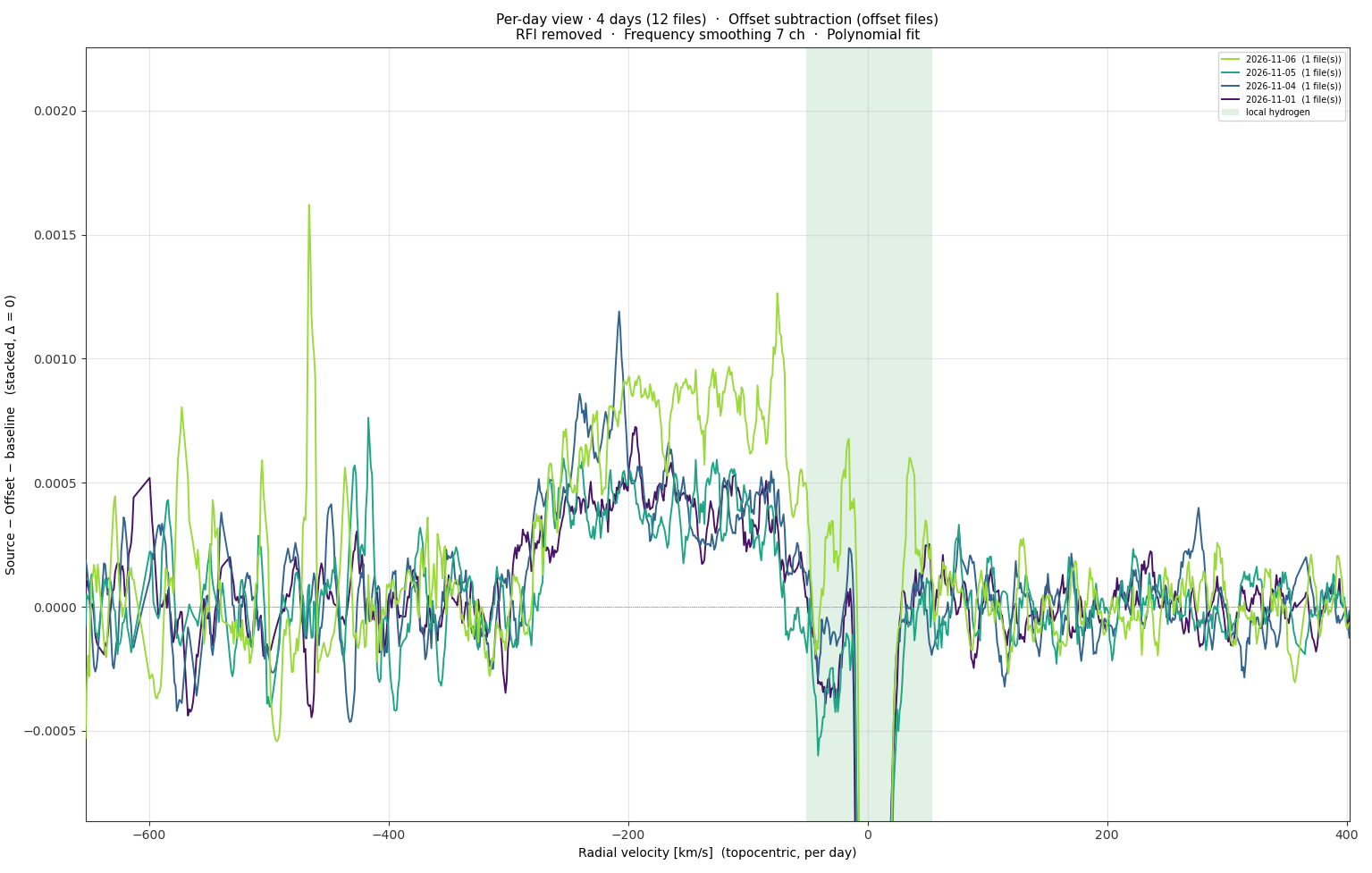
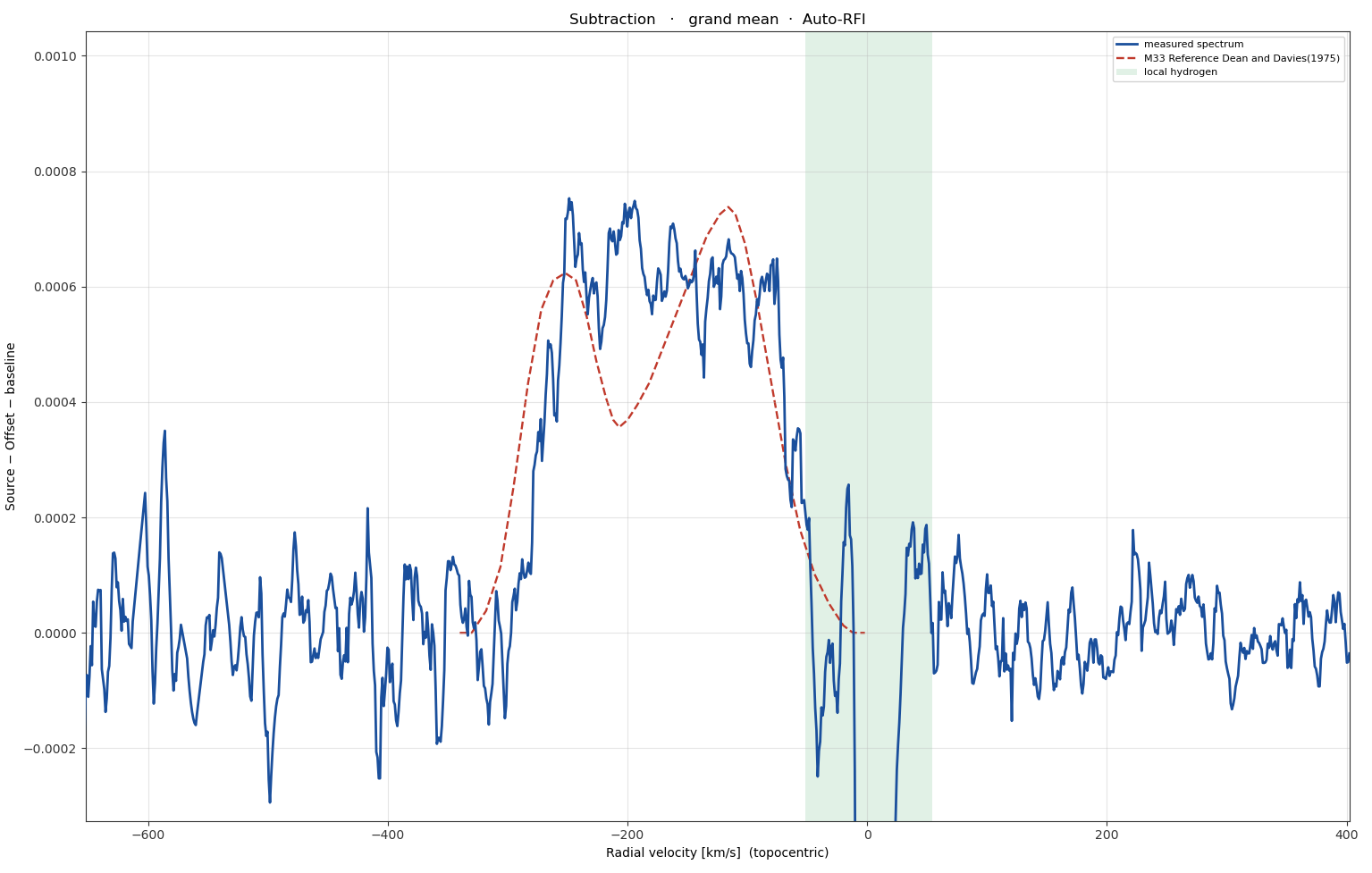
Attached are the first results from the new series of observations of M33 using a 1.8-m dish and an Airspy as an SDR. Observations were made over several nights. The observation proceeded, like in the case of m31, as follows per cycle: 1. One hour of reference measurement before the transit of the source (offset1) 2. One hour of observation on source 3. One hour of reference measurement after the transit of the source (offset2) Sixty measurements per hour (each measurement with a 60-second integration time). Afterward, the mean value from the offset files was subtracted from the mean value of the source observation. The goal of this procedure is to obtain a baseline that is as smooth as possible and to eliminate a large portion of the local hydrogen signal through offset subtraction. However, a significant portion of the hydrogen signal remains, since not all of it can be eliminated by offset subtraction. Since the hydrogen signal is slightly stronger at the offset during the M33 measurement, the hydrogen signal appears negative after offset subtraction. During post-processing, narrowband RFI was removed, the spectrum was smoothed across 7 frequency channels (using dynamic averaging), and a polynomial fit was applied to straighten the baseline. Overall, the Airspy performs better than the SDR Play, as it has a significantly smoother baseline. It is almost straight, and the M33 signal was already discernible even without the polynomial fit, but it stands out even more clearly as a result of it.