Observation Methods
Observing Continuum Radio Sources
In radio astronomy, continuum sources such as the Sun, Moon, and strong radio galaxies can be observed using different techniques. Three commonly used methods are on-source observations, drift scans, and raster scans.
On-Source Observations
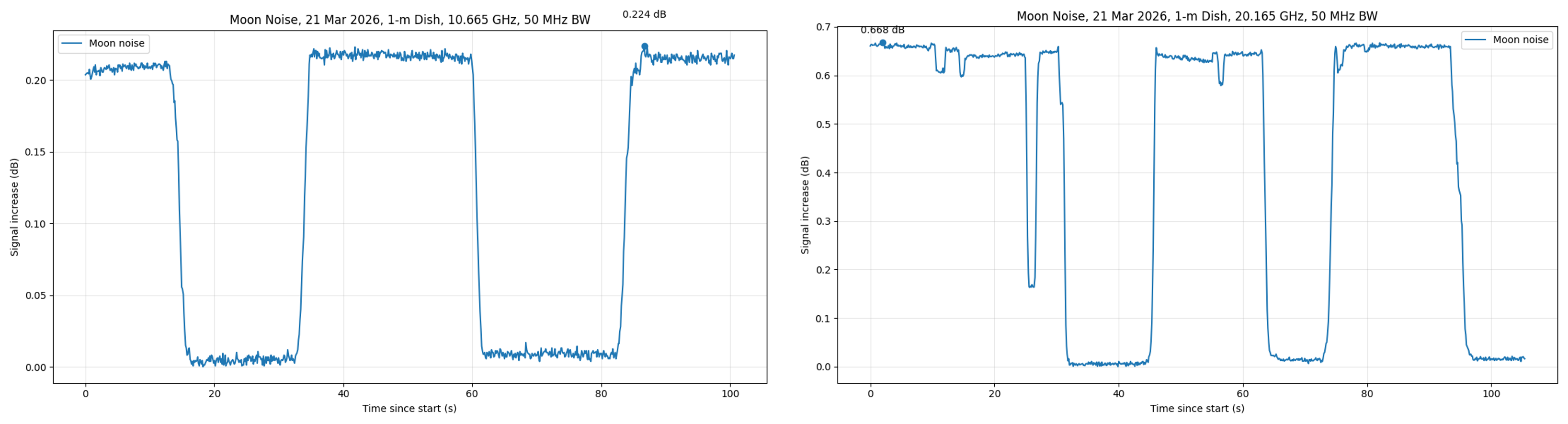
In an on-source observation, the radio telescope is pointed directly at the target and remains fixed on its position, usually tracking its movement across the sky. The received signal is recorded over time, allowing long integration periods to improve the signal-to-noise ratio. Measurements of the background emission (off-source) can be used for comparison.
Drift Scans
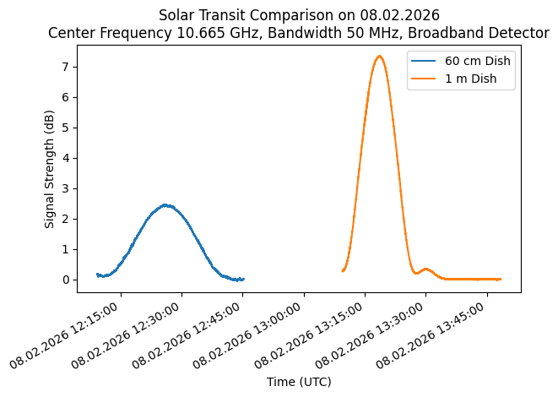
In a drift scan, the telescope remains fixed at a particular azimuth and elevation while the rotation of the Earth causes the radio source to pass through the antenna beam. The recorded signal typically increases as the source enters the beam, reaches a maximum near the beam center, and decreases as the source moves out. Drift scans are particularly useful for detecting radio sources, measuring their relative intensity, and estimating the antenna beam width.
Raster Scans
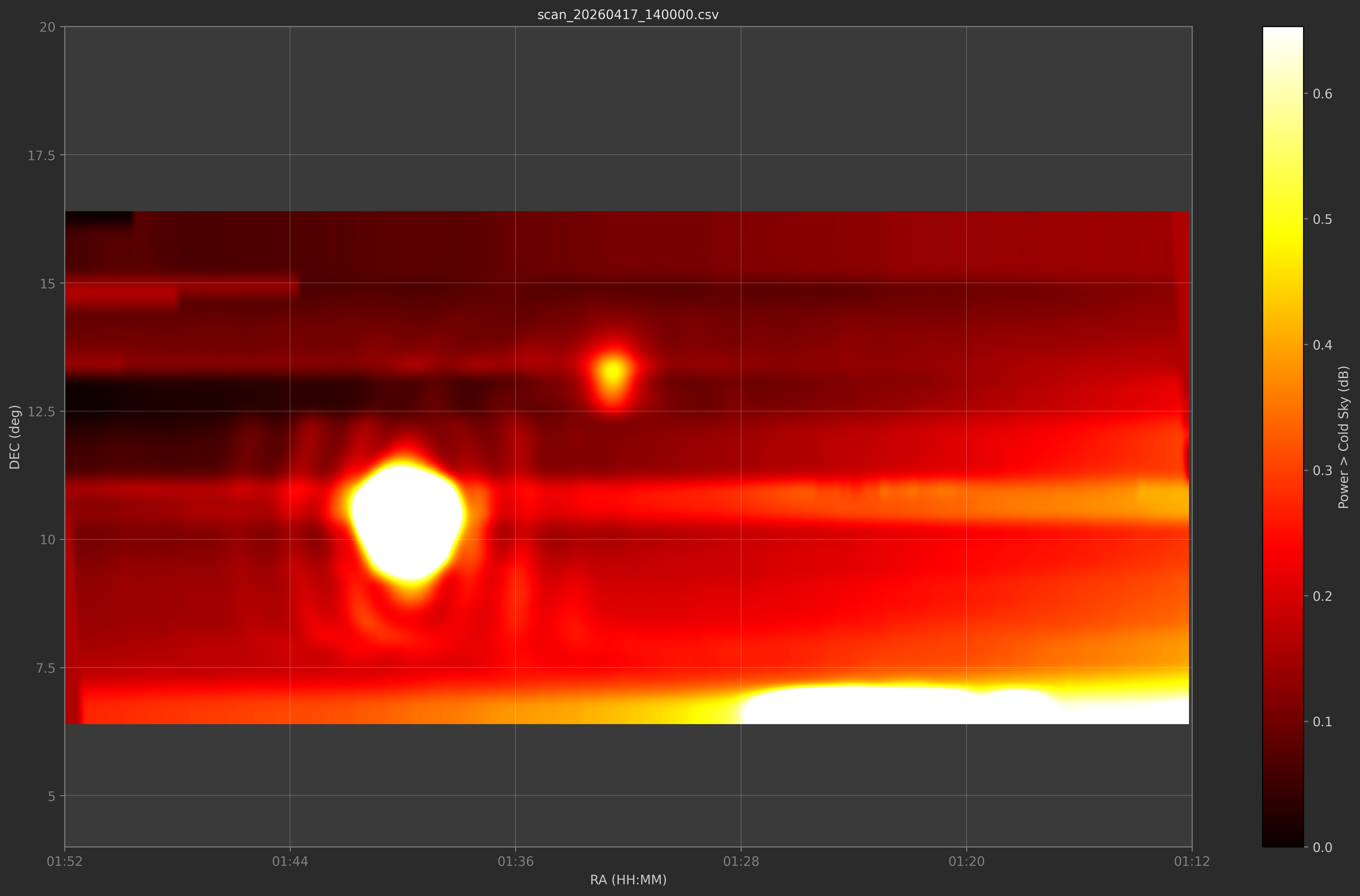
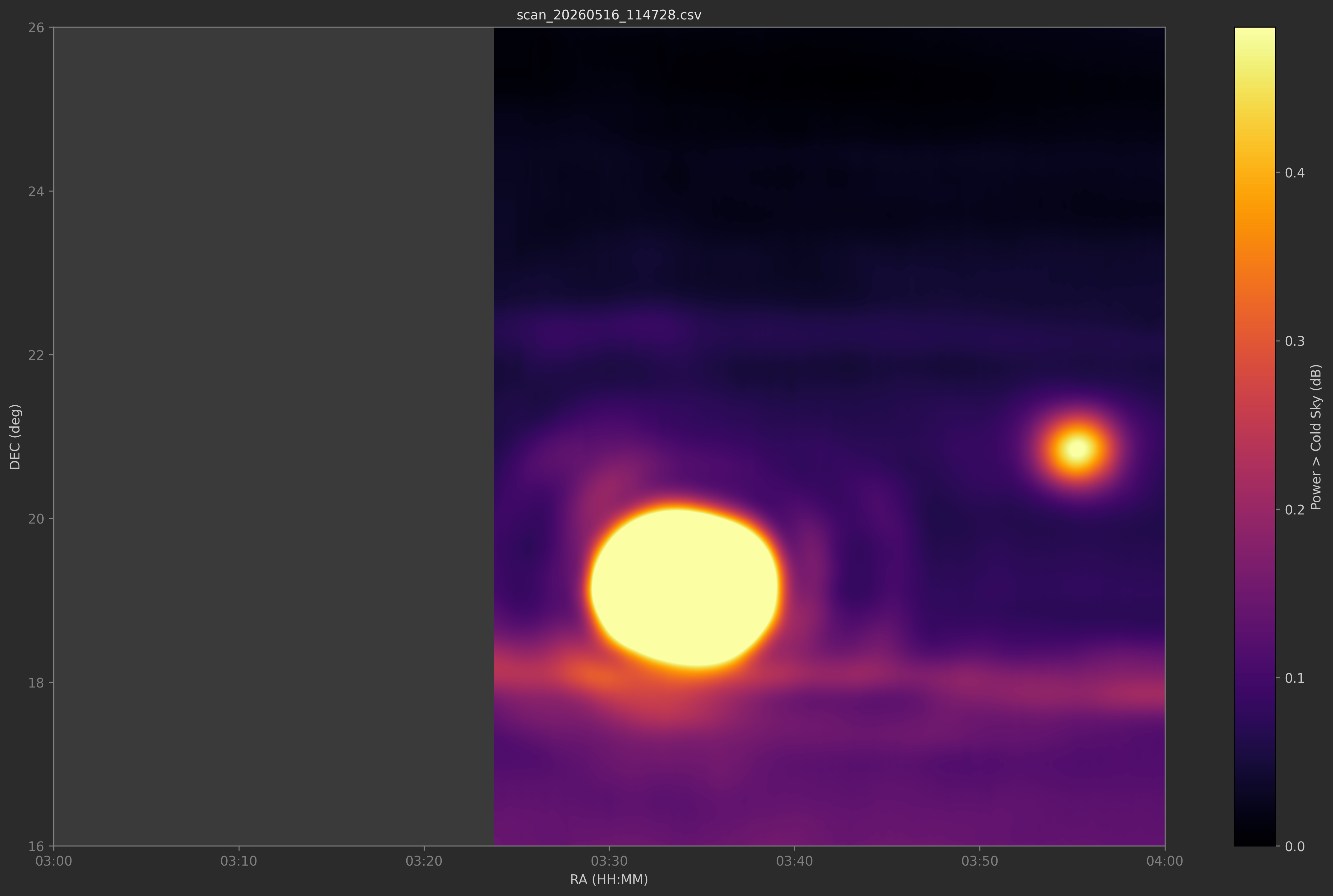
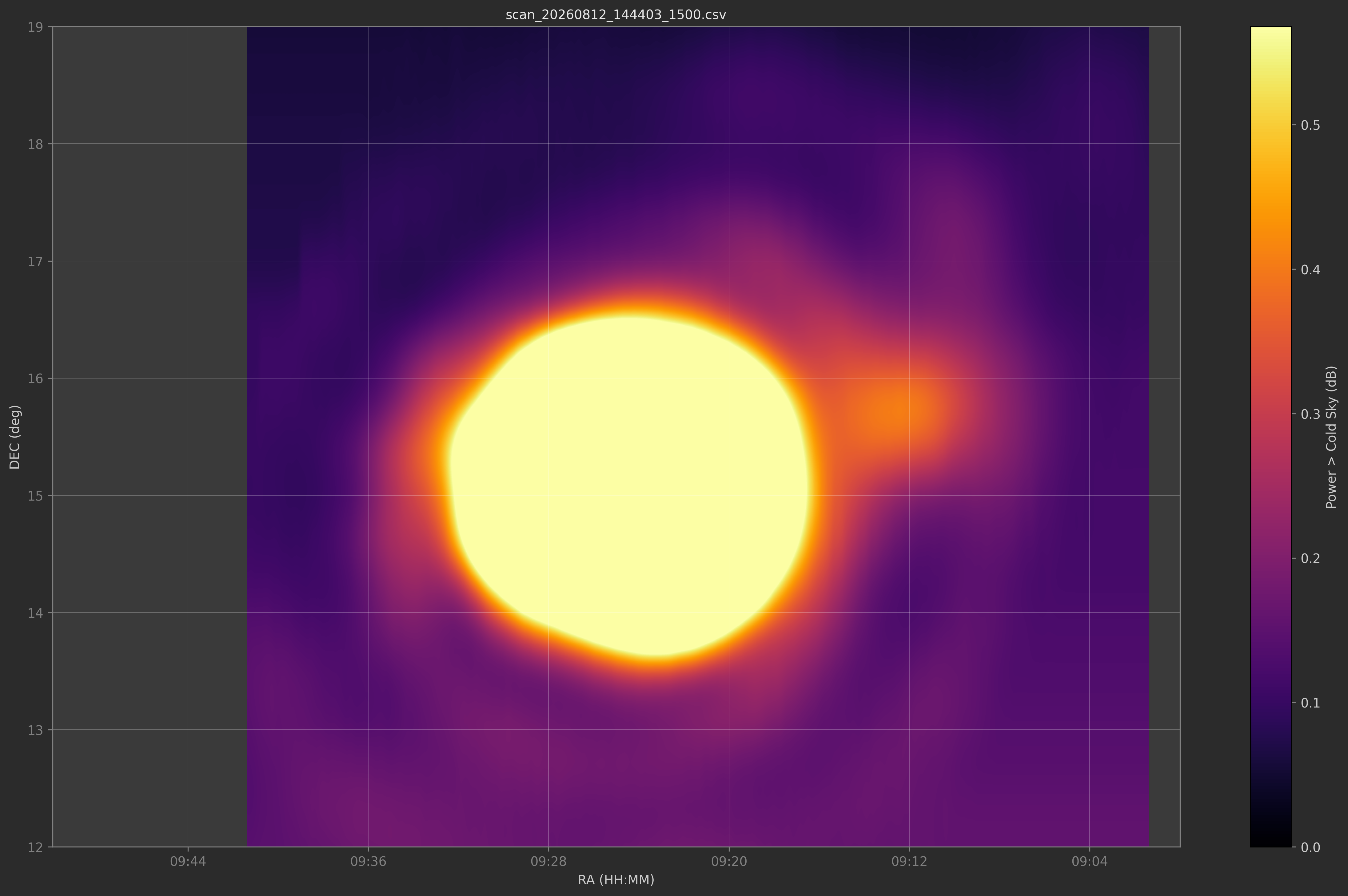
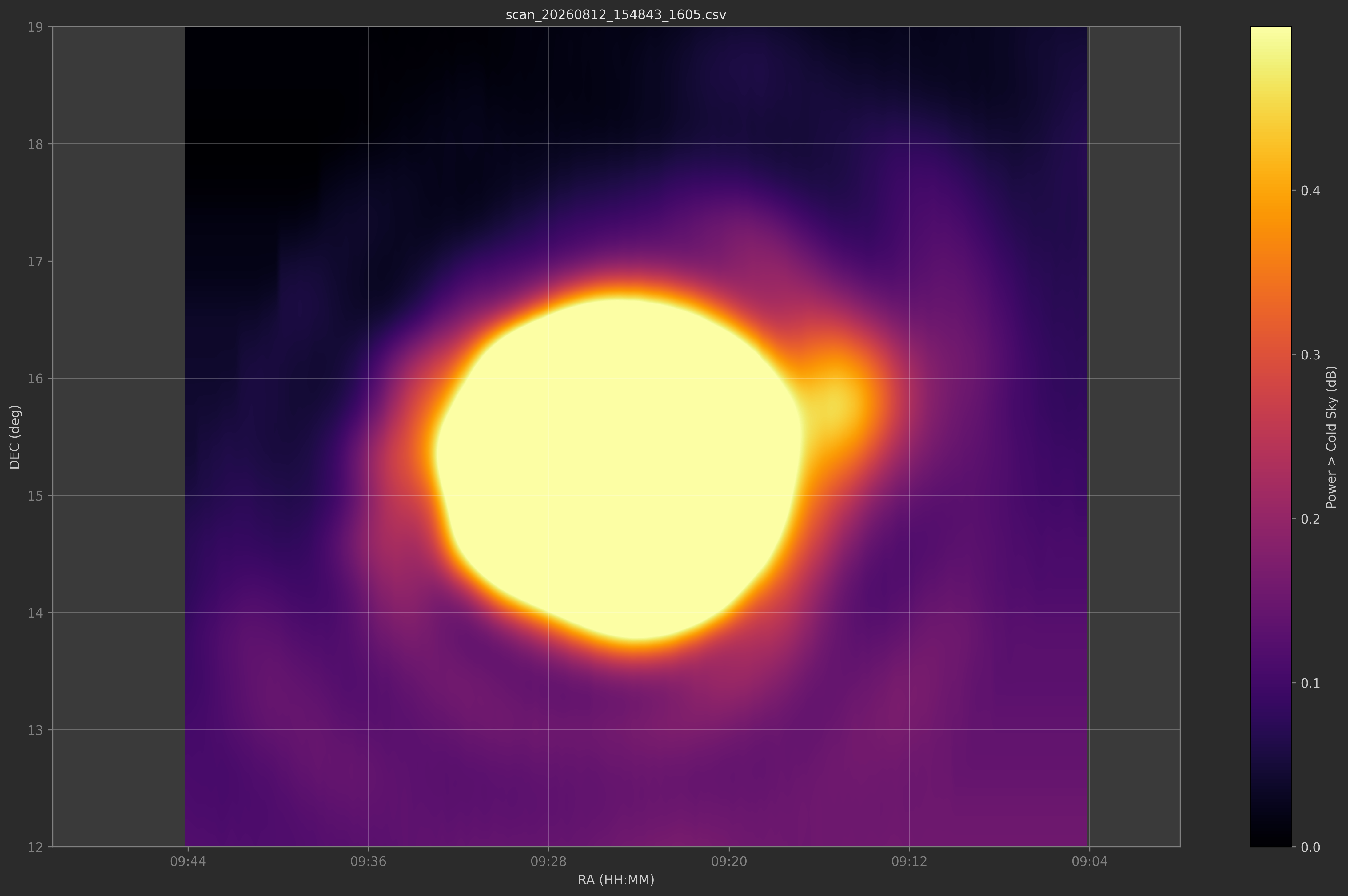
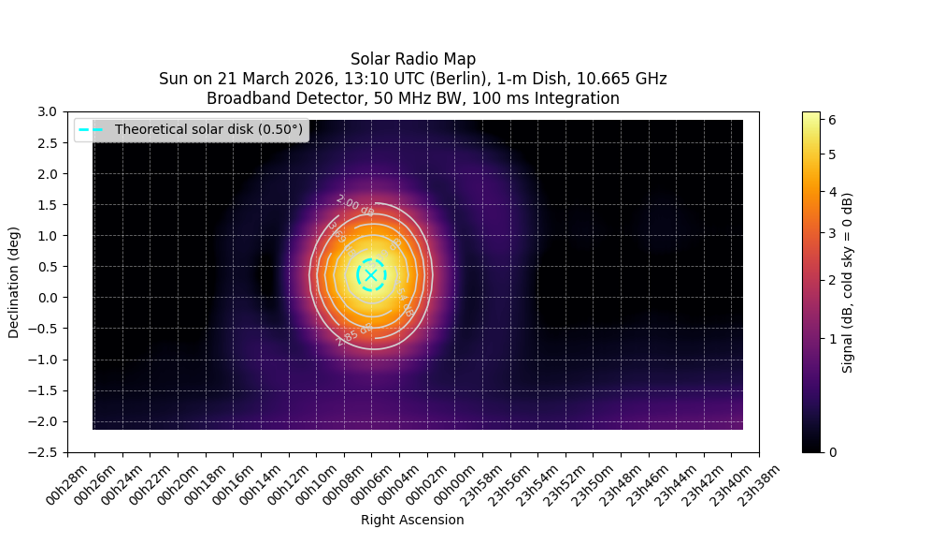
A raster scan is used to create a two-dimensional radio map of an astronomical object. The telescope systematically scans across a region of the sky in a series of parallel lines, recording the signal intensity at each position. The measurements are then combined to reconstruct an image showing the spatial distribution of radio emission. The resulting resolution depends primarily on the antenna beam width and the spacing between scan lines.
Examples of Raster Scans
The following images illustrate raster scan observations of the new Moon in the vicinity of the Sun. These examples demonstrate how radio mapping techniques can reveal the distribution of continuum emission and how different astronomical objects appear at radio wavelengths.