Continuum Observations
Continuum observations are characterized by the study of objects that emit radio waves across a very broad and continuous portion of the radio spectrum.
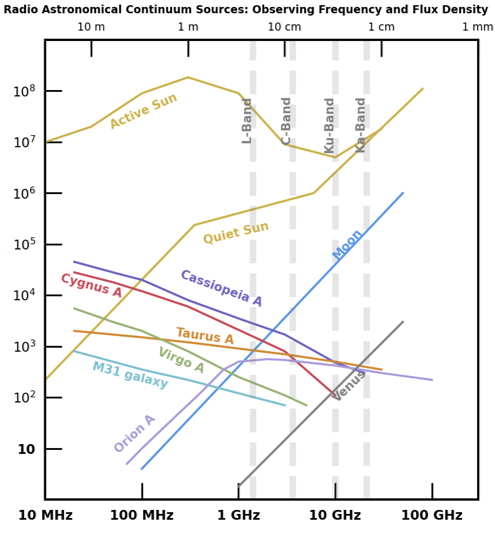
The figure shows flux densities of selected continuum sources in Jansky (Jy) as a function of frequency. Continuum sources emit radio radiation over a wide spectral range. In general, thermal emitters are easier to observe at higher frequencies, while non-thermal emitters are more prominent at lower frequencies.
For amateur radio astronomers, four frequency bands are particularly relevant. Each band offers specific advantages and disadvantages. At higher frequencies, terrestrial interference is typically reduced, but satellite interference and atmospheric absorption tend to increase.
Because many amateur setups are based on modified satellite television reception equipment, this presentation focuses mainly on the higher microwave bands (Ku and Ka). Nevertheless, continuum observations have also been successfully performed in the L-band, and these results will be presented as well. Observations in the C-band have not yet been carried out, but are planned for future experiments.
Continuum radio astronomy can be conducted with very simple and low-cost equipment. Satellite TV dishes are widely available at minimal cost — and are often obtainable free of charge through online marketplaces. With modest modifications, such antennas can be transformed into small radio telescopes. Using these instruments, a wide range of interesting and scientifically meaningful radio astronomy experiments can be performed.
In particular, strong continuum sources such as the Sun and the Moon can be observed reliably. This presentation demonstrates practical methods for observing continuum radio sources using satellite dishes in combination with a self-built broadband detector.
Four different satellite dishes were employed in the experiments:
a 60 cm Cassegrain dish
a 60 cm offset dish
a 1-meter prime-focus dish (Technisat)
a 1.8-meter prime-focus satellite dish
Various Ku-band and Ka-band LNBs were tested. The 1-meter dish was used with an Invacom Ku-band LNB and a Norsat Ka-band LNB. The Cassegrain dish features an integrated Ku-band LNB. The offset dish was operated both with a commercial Ku-band LNB designed for offset reflectors and with a Ka-band LNB originally intended for receiving Irish television programmes via Eutelsat satellites.
All dishes were mounted on equatorial mounts, enabling drift scans and transit observations.
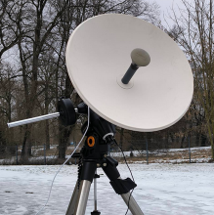
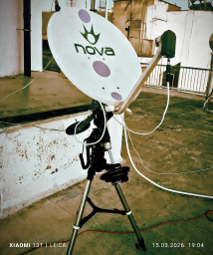
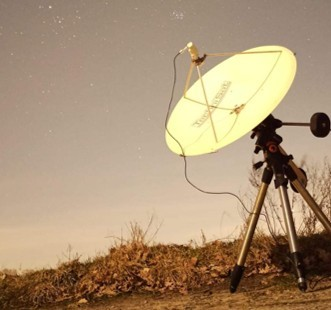
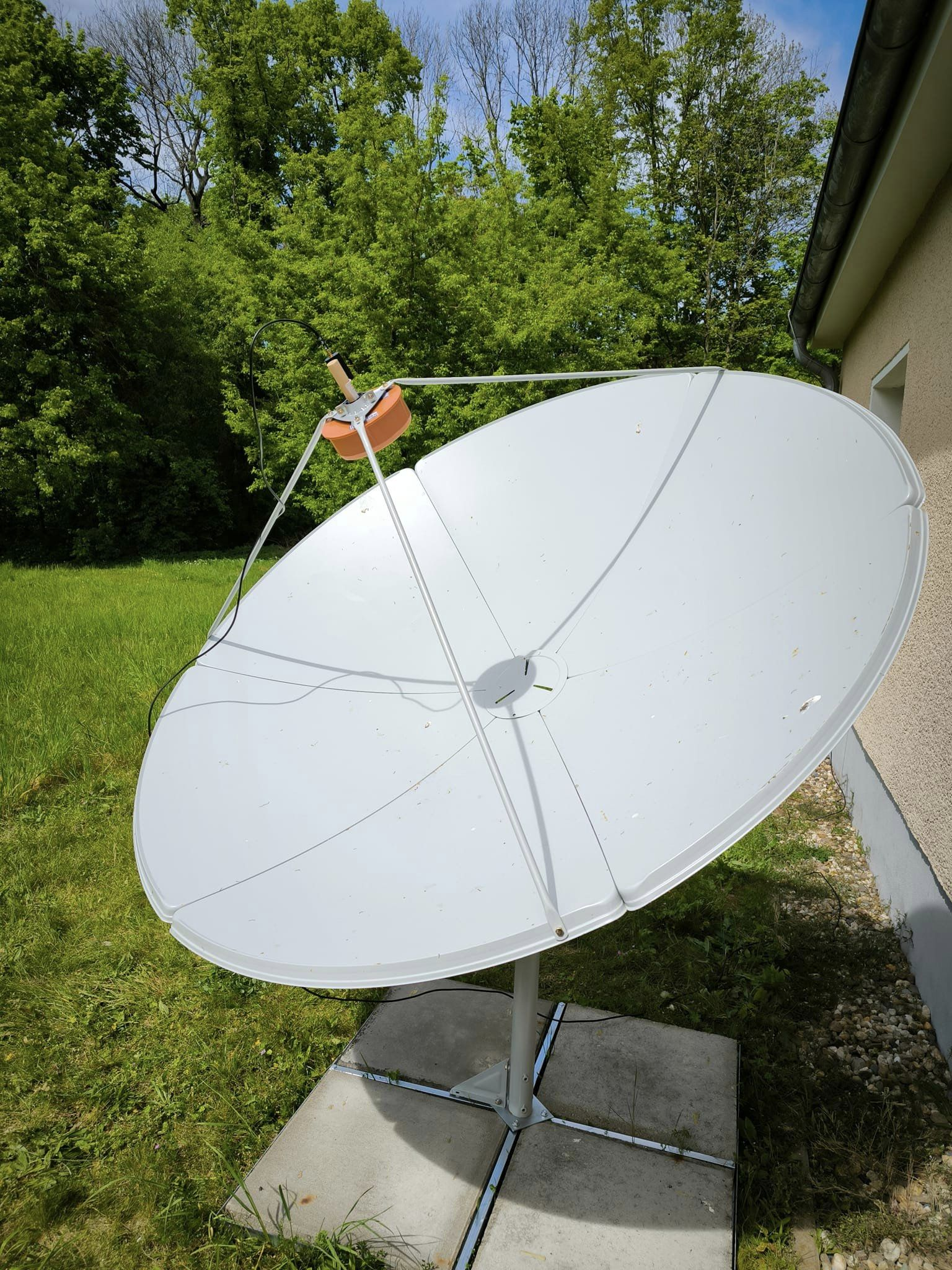
In addition, the 1.8-meter prime-focus dish — originally designed for C-band reception — was equipped with a loop feed for L-band observations at 1420 MHz. In this configuration, both software-defined radios (such as RTL-SDR and SDRplay) and our self-developed broadband detector (“second receiver”) were used. This detector system is described in more detail in the Projects section.
Our experiments demonstrate that continuum radio astronomy is accessible, affordable, and highly rewarding for amateur astronomers, enabling meaningful observations with relatively simple instrumentation.
To begin with, we take a closer look at the theoretical foundation of continuum observations using the radiometer equation. This allows us to explore how weak radio sources can be detected even with relatively simple equipment.
In the next step, we present a series of small, practical experiments that are easy to reproduce. These examples provide hands-on insight into key aspects of continuum observations and help build an intuitive understanding of the underlying principles.
Finally, we showcase the results of our observations of various radio sources. For each example, we explain how the observations were carried out, how they can be replicated, and what can be learned from them.
Back to top