Maser Observations
Detecting Natural Microwave Lasers from a Stellar Nursery
The Orion KL region, located deep inside the famous Orion Nebula, is one of the most active star-forming regions in the night sky. Hidden behind dense clouds of dust, it is invisible in optical light but shines brightly at infrared and radio wavelengths. Among its most remarkable features are naturally occurring water masers—intense microwave emissions produced by water molecules in the turbulent environment surrounding newly forming stars.
A maser (Microwave Amplification by Stimulated Emission of Radiation) is the microwave equivalent of a laser. Under the right physical conditions, water molecules emit radiation at a very specific frequency of 22.23508 GHz. These emissions can become extraordinarily bright, making Orion KL one of the few deep-space radio sources that can be detected with relatively modest amateur radio telescopes.
Despite being located approximately 1,300 light-years away, the strongest maser components of Orion KL are powerful enough to be observed with a satellite television dish only one meter in diameter.
Equipment and Observing Setup
The observations were performed using a compact radio astronomy system based largely on commercially available satellite-TV components.
Equipment
- 1-meter satellite dish
- Celestron AVX equatorial mount for tracking
- Norsat 9000LDF Ka-band LNB
- SDRplay receiver
- SDR Console software
- Radio Sky Spectrograph for data recording
- Microsoft Excel for data analysis
Figure 1: Radio Telescope Setup
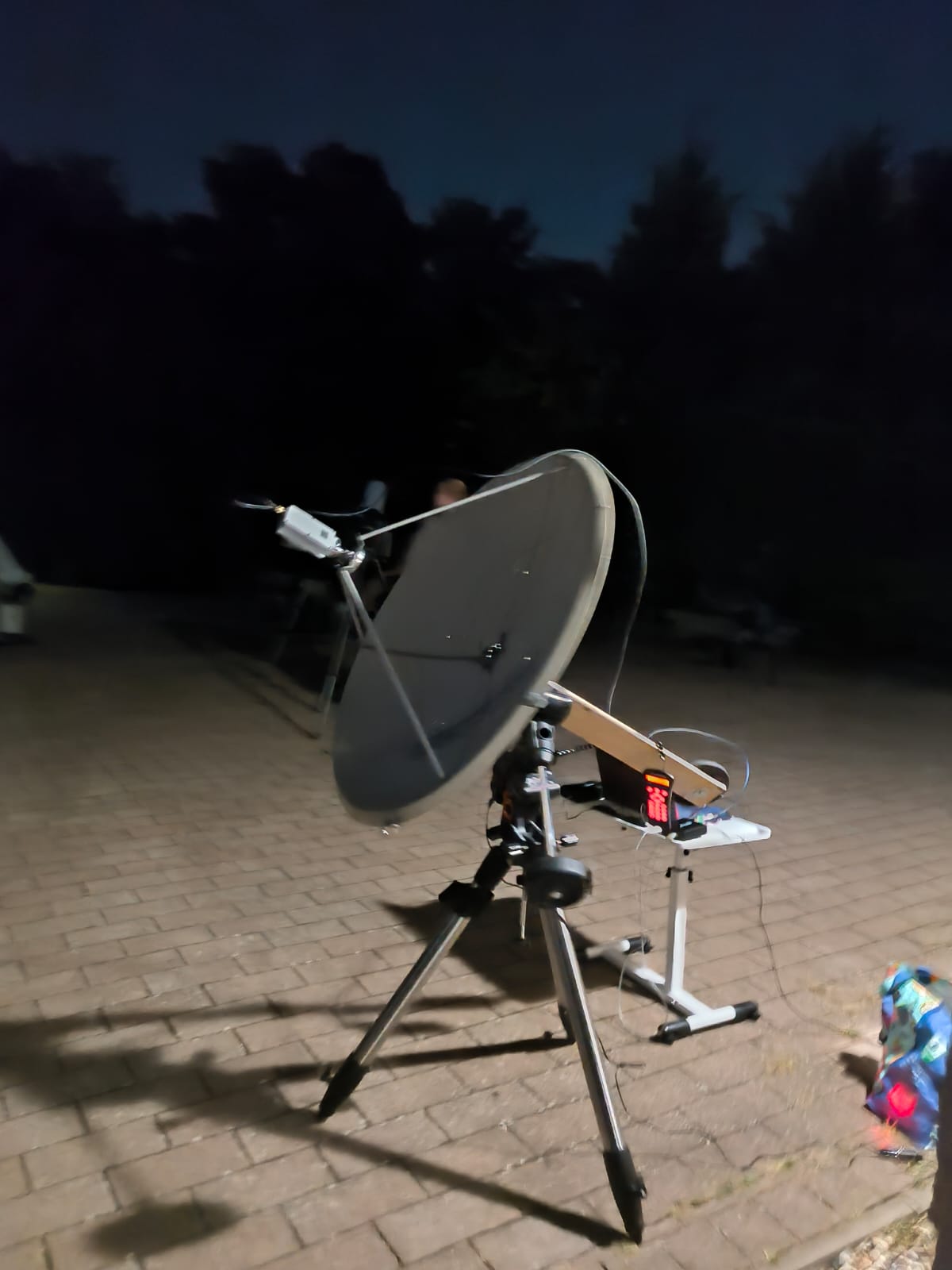
At 22 GHz, a 1-meter dish has a Half Power Beam Width (HPBW) of approximately 1°. Accurate pointing is therefore essential. Even a small pointing error can significantly reduce the received signal strength.
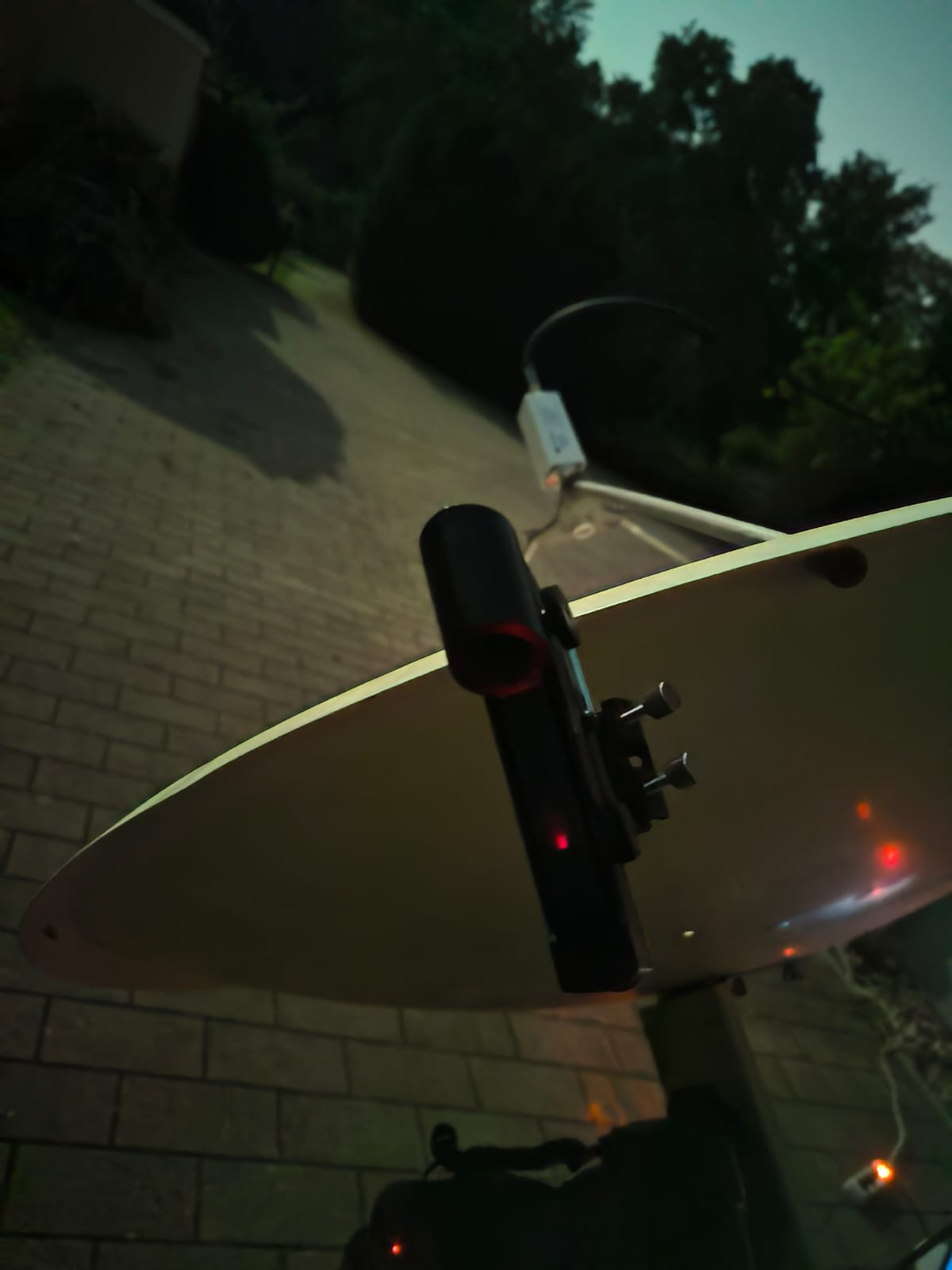
For the observation, the telescope tracked Orion KL continuously for approximately one hour. An additional off-source measurement was recorded several degrees away from Orion to characterize receiver and sky background effects.
Recording the Maser Signal
The water maser emission appears as an extremely narrow spectral line embedded in receiver noise and instrumental baseline variations. Unlike observations of the Sun or Moon, the signal cannot be detected simply by measuring total power. Instead, spectral analysis is required.
After collecting the data, the off-source spectrum was subtracted from the Orion observation. This procedure removes much of the instrumental response and helps reveal weak spectral features.
A narrow emission line became visible near 22.2324 GHz, close to the expected frequency of the Orion KL water maser after accounting for Doppler shifts.
To verify that the signal was real and not an artifact, the data were also displayed as a waterfall diagram.
Figure 2: Waterfall Diagram and Spectrum
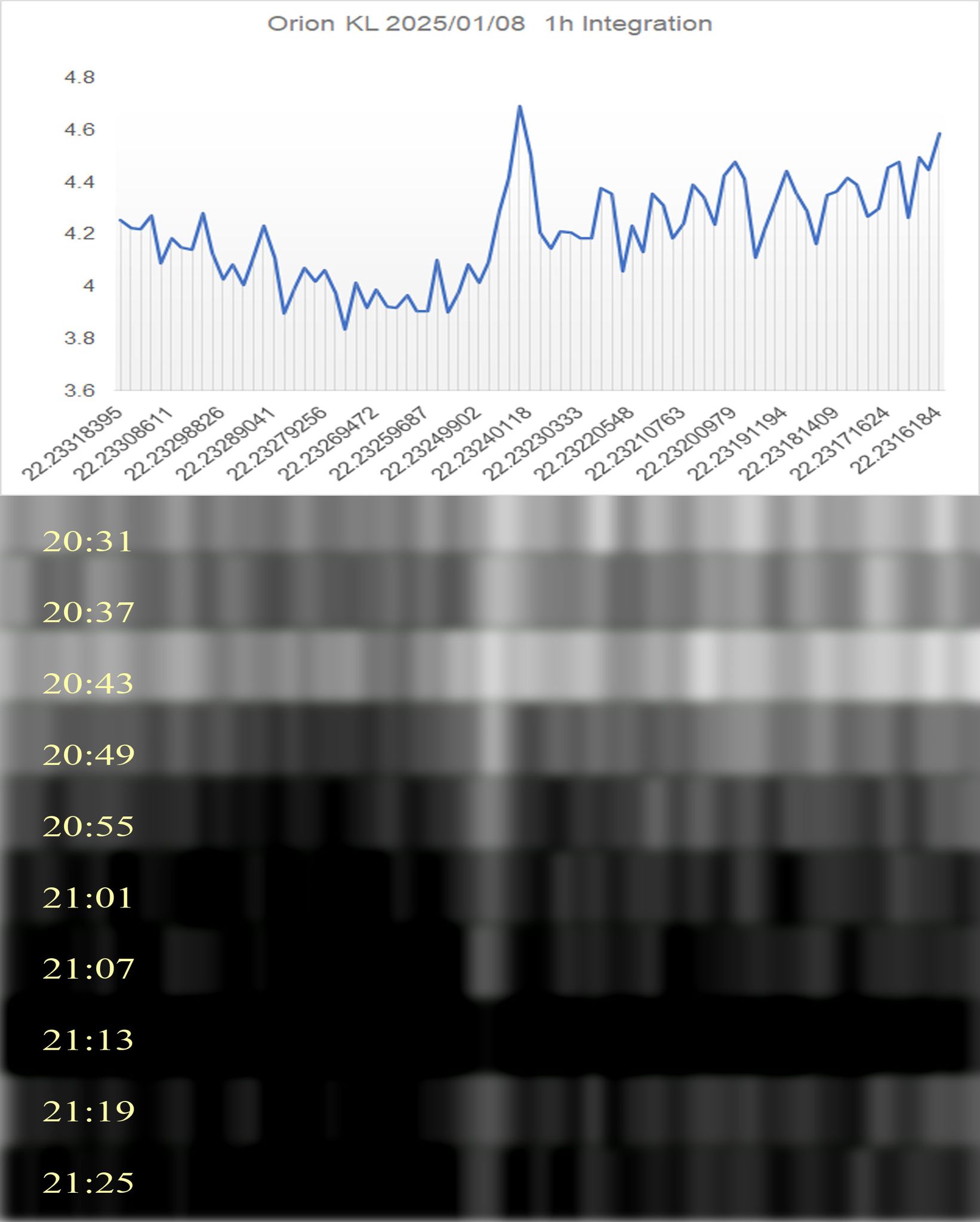
The waterfall diagram demonstrates that the spectral feature remains visible throughout the entire observation. A genuine astronomical signal should persist over time, whereas random noise spikes generally appear only briefly.
A slight frequency drift can be seen in the signal. This is most likely caused by local oscillator instability within the receiving system, although small Doppler variations due to Earth’s rotation also contribute.
Converting Frequency into Radial Velocity
Astronomers usually describe maser emissions in terms of radial velocity rather than frequency. The observed frequency differs slightly from the laboratory rest frequency because of the Doppler effect.
For water masers, the rest frequency is:
[ f_0 = 22.23508 ]
To compare observations with professional measurements, the spectrum was converted into velocities relative to the Local Standard of Rest (LSR). I used an online converter (http://f4klo.ampr.org/vlsrKLO.php) for this and you can find different of them on various websites online. This correction removes the effects of Earth’s rotation and orbital motion.
The expected velocity range of Orion KL water masers can be obtained from the MaserDB database. Additional velocity corrections can be calculated using online VLSR calculators commonly used by amateur radio astronomers.
Because the source is extremely weak, residual baseline curvature remained visible even after subtracting the reference spectrum. To remove this effect, a polynomial baseline fit was applied.
Figure 3: Spectrum in VLSR Coordinates
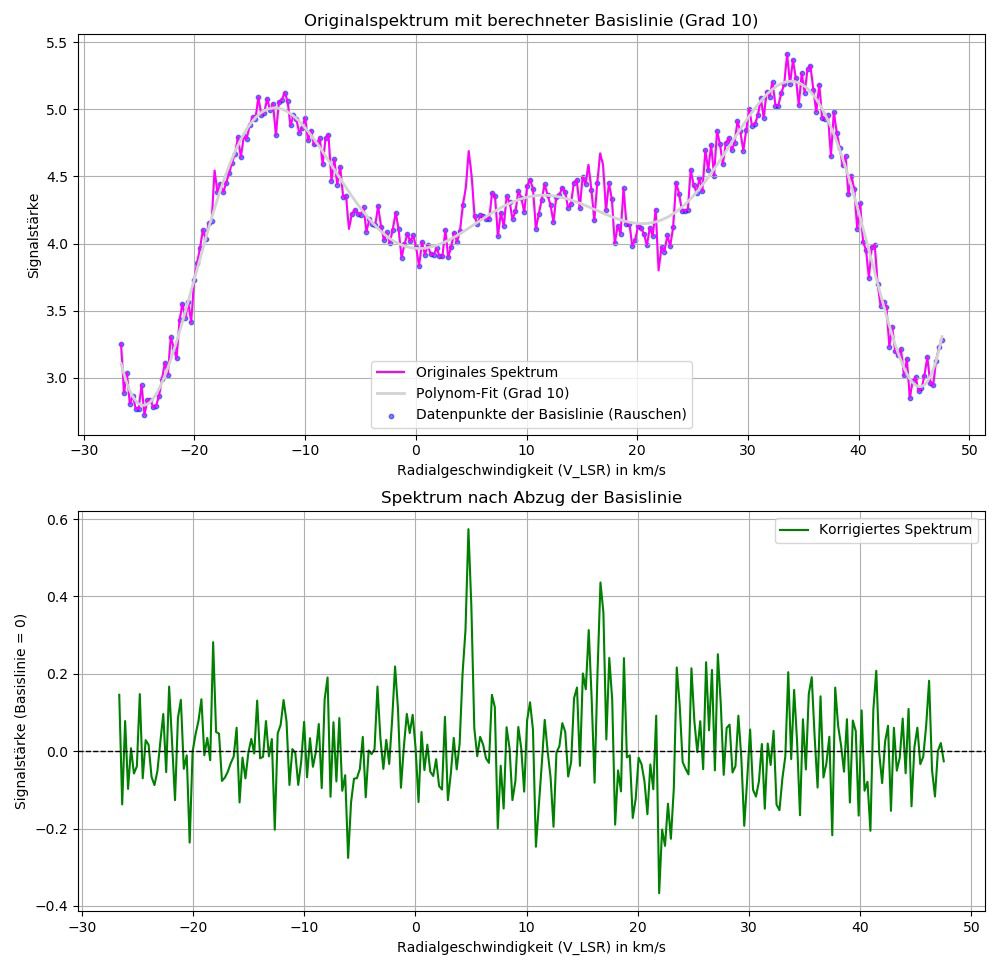
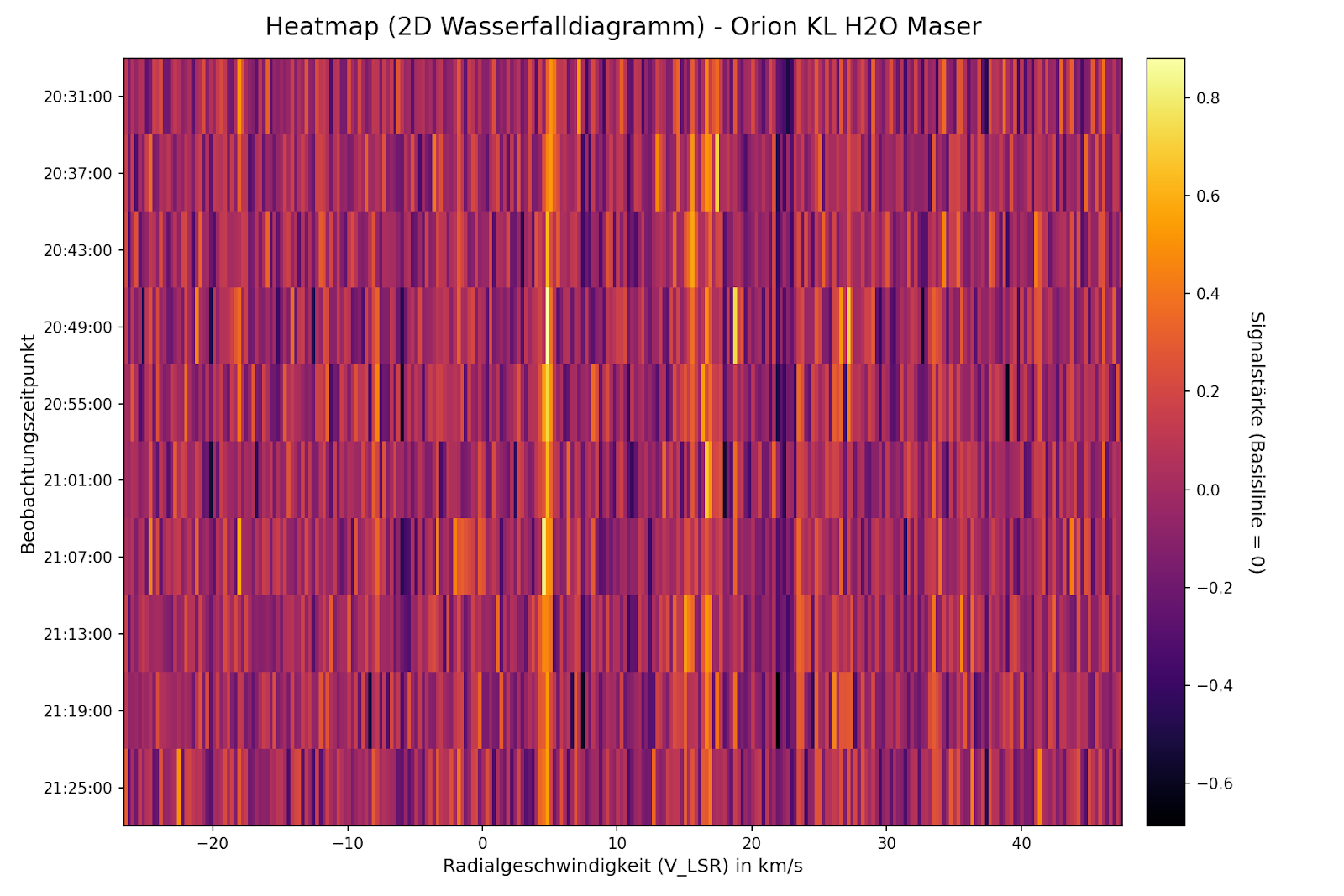
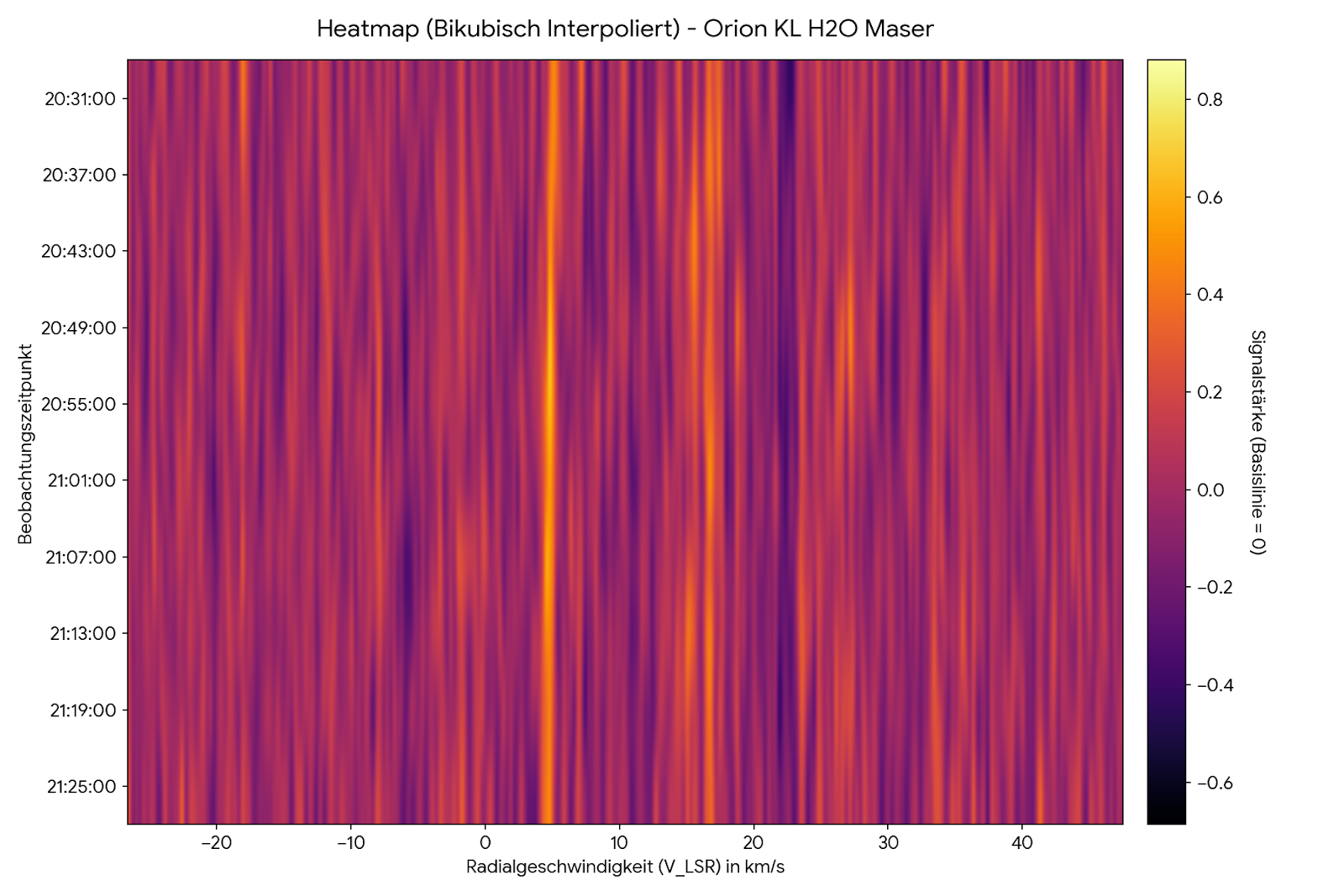
After baseline removal, the strongest maser component becomes clearly visible near +5 km/s. A broader secondary feature is also present around +15 km/s.
Both velocity components fall within the range reported by professional maser observations and international maser catalogues. The exact velocities of Orion KL masers are known to vary over time as a result of dynamic processes occurring within the star-forming region.
Converting the waterfall spectrum into VLSR values and adding a polinomial fit shows the spectrl line of the maser as a continous line from the beginning to the end of the observation.
Why Water Masers Are Important
Water masers originate in dense molecular clouds where new stars are forming. Shock waves, stellar winds, and energetic outflows create physical conditions that allow water molecules to amplify microwave radiation naturally.
Because masers are extremely bright and often highly variable, they are valuable tools for studying:
- Star formation processes
- Gas dynamics in molecular clouds
- Protostellar jets and outflows
- Galactic structure and kinematics
Many of the strongest masers can be monitored regularly by amateur radio astronomers, making them one of the few truly deep-space spectral-line targets accessible with relatively small instruments.
How to Repeat the Observation
One of the most fascinating aspects of Orion KL is that it can be observed with equipment originally designed for satellite television reception.
For successful observations, the following points are particularly important:
- Use a dish of at least 1 meter diameter.
- Employ a stable Ka-band LNB capable of receiving the 22 GHz water line.
- Track Orion KL accurately throughout the observation.
- Record spectral data rather than total power measurements.
- Integrate for at least one hour.
- Record an off-source reference spectrum.
- Convert frequencies into VLSR velocities for comparison with published data.
- Apply baseline correction techniques such as polynomial fitting to reveal weak features.
Longer integration times and careful calibration can further improve the signal-to-noise ratio and make weaker maser components visible.
Conclusion
The observation demonstrates that amateur radio astronomers can detect one of the most famous interstellar water masers using relatively simple equipment. With careful calibration, stable receivers, and long integration times, it is possible to observe physical processes occurring in a stellar nursery more than a thousand light-years from Earth.
Detecting the Orion KL water maser is a rewarding project that combines radio astronomy, signal processing, and astrophysics. It illustrates how modern software and commercially available hardware have made professional-style spectral-line observations accessible to dedicated amateurs.