Spectroscopy
In addition to continuum observations, objects that emit spectral line radiation represent a second important class of targets in amateur radio astronomy. These are sources that do not emit radio waves across a broad, continuous spectrum, but instead within a specific, well-defined frequency range.
The most prominent example is our own galaxy, the Milky Way, which “shines” at 1420 MHz, the spectral line of neutral hydrogen (H I). This emission originates from the well-known 21-cm transition of the hydrogen atom. Since the signal is relatively strong, it can already be observed with simple equipment, making it an ideal entry point into radio spectroscopy.
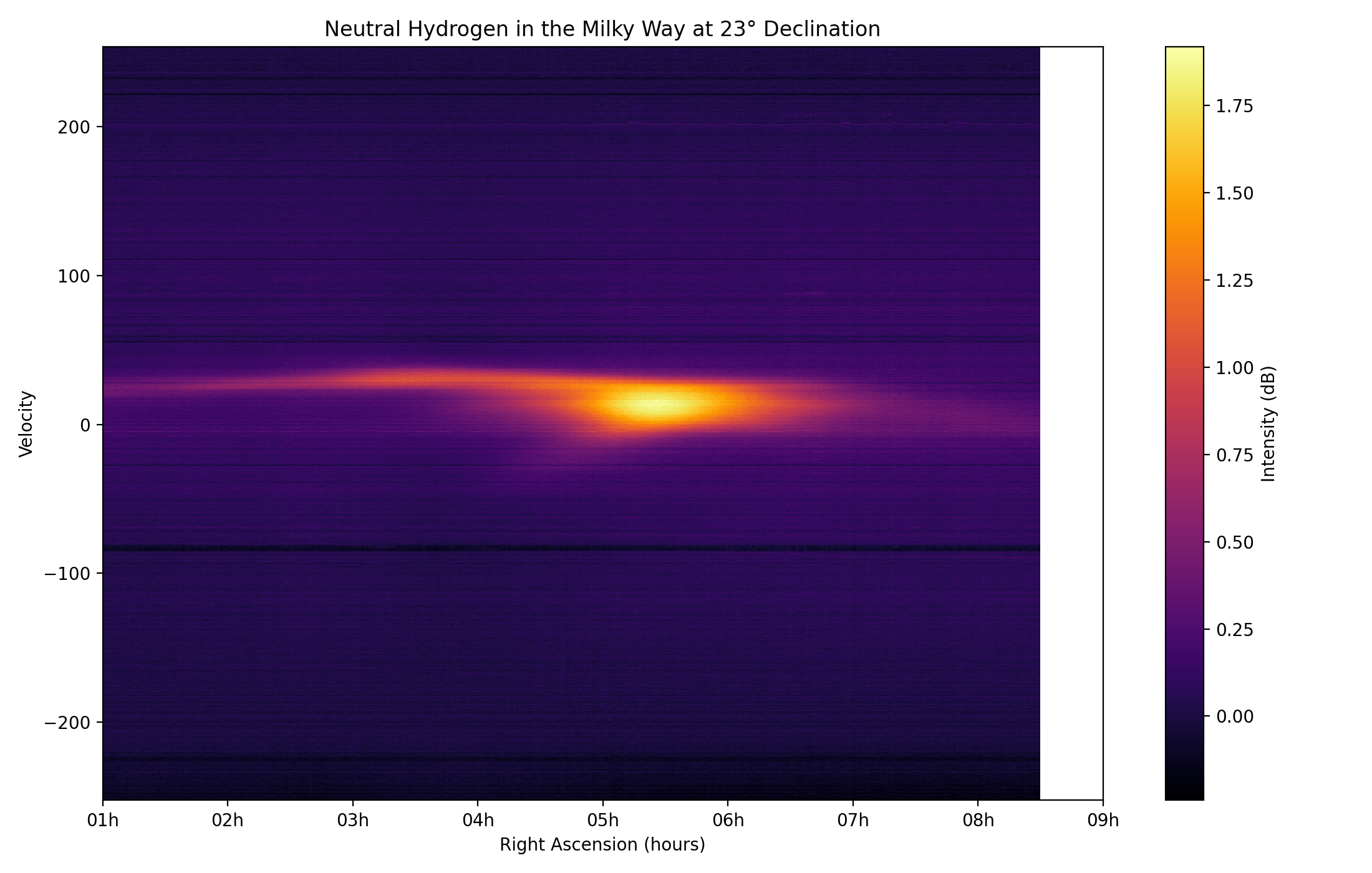
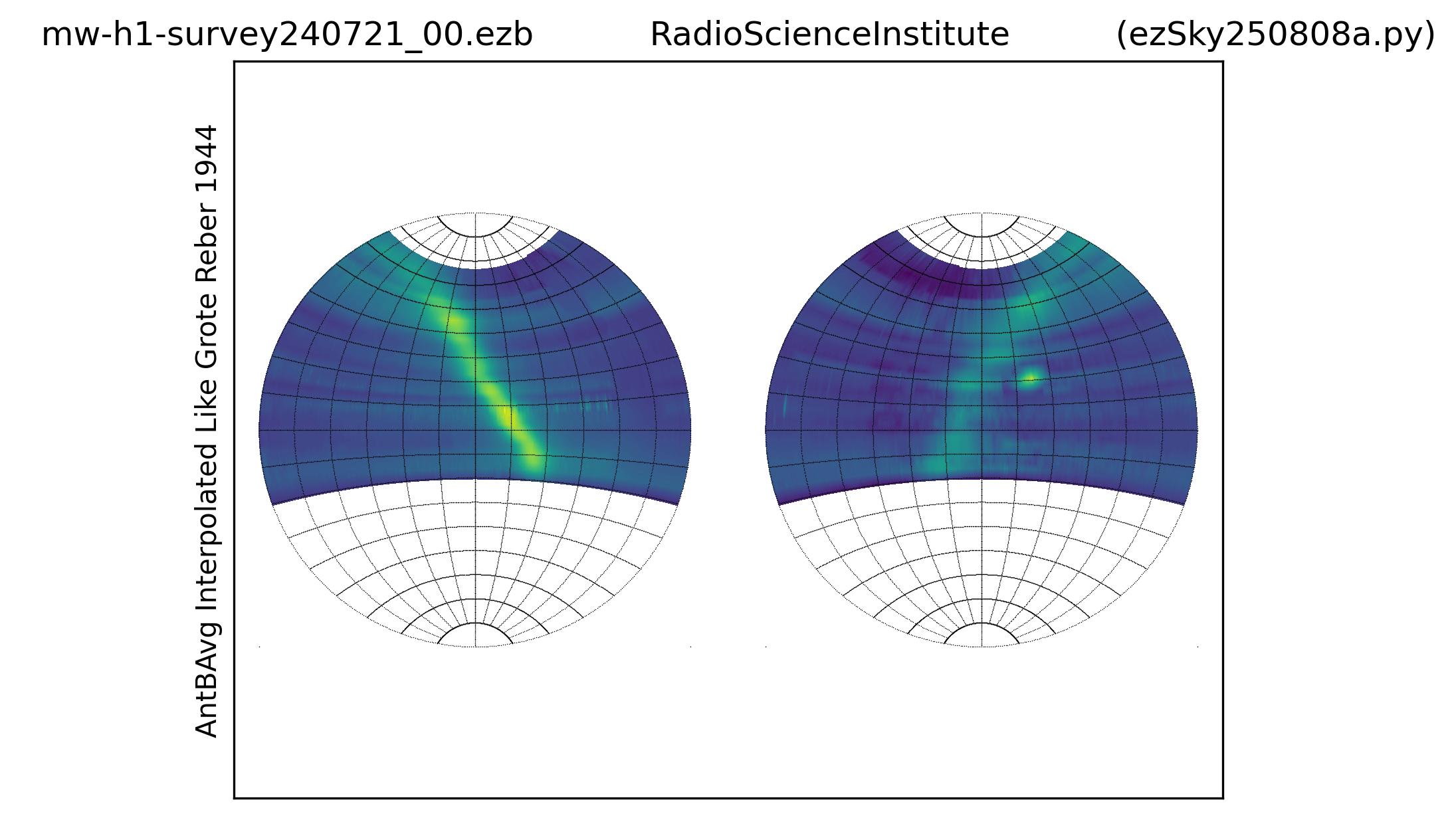
Other galaxies can also be observed in the light of neutral hydrogen. However, due to their much greater distances, their signals are significantly weaker and require more advanced setups, including larger antennas, lower system temperatures, and longer integration times.
In addition to the hydrogen line, many other spectral lines exist, particularly from molecules. Of special interest are maser emissions (Microwave Amplification by Stimulated Emission of Radiation). These occur under specific physical conditions in astronomical objects, such as star-forming regions. Maser sources can produce extremely intense, narrowband signals that are sometimes strong enough to be detected even with amateur equipment.
A major advantage of observing spectral line sources is that they provide significantly more physical information than continuum sources. Unlike continuum radiation, spectral lines allow the use of the Doppler effect. By measuring small frequency shifts of a known spectral line, it is possible to determine the radial velocity of an object relative to the observer. In many cases, this also enables conclusions about the distance and dynamics of astronomical objects, such as the rotation of the Milky Way or the motion of gas clouds within galaxies.
On the following pages, you will find practical examples of spectroscopic observations:
Observations of the Milky Way in the light of neutral hydrogen (H I)
Observation of a water maser in the star-forming region of the Orion Nebula (Orion KL)