Moon
This section focuses on the radio observation of the Moon using a small radio telescope. Similar to the measurements of the Sun, these observations allow the determination of brightness temperatures of the lunar surface.
The Moon is a thermal emitter, and its radio emission can be described as blackbody radiation originating from the regolith. However, unlike the Sun, the observed radiation strongly depends on both:
- the observing frequency
- the lunar phase
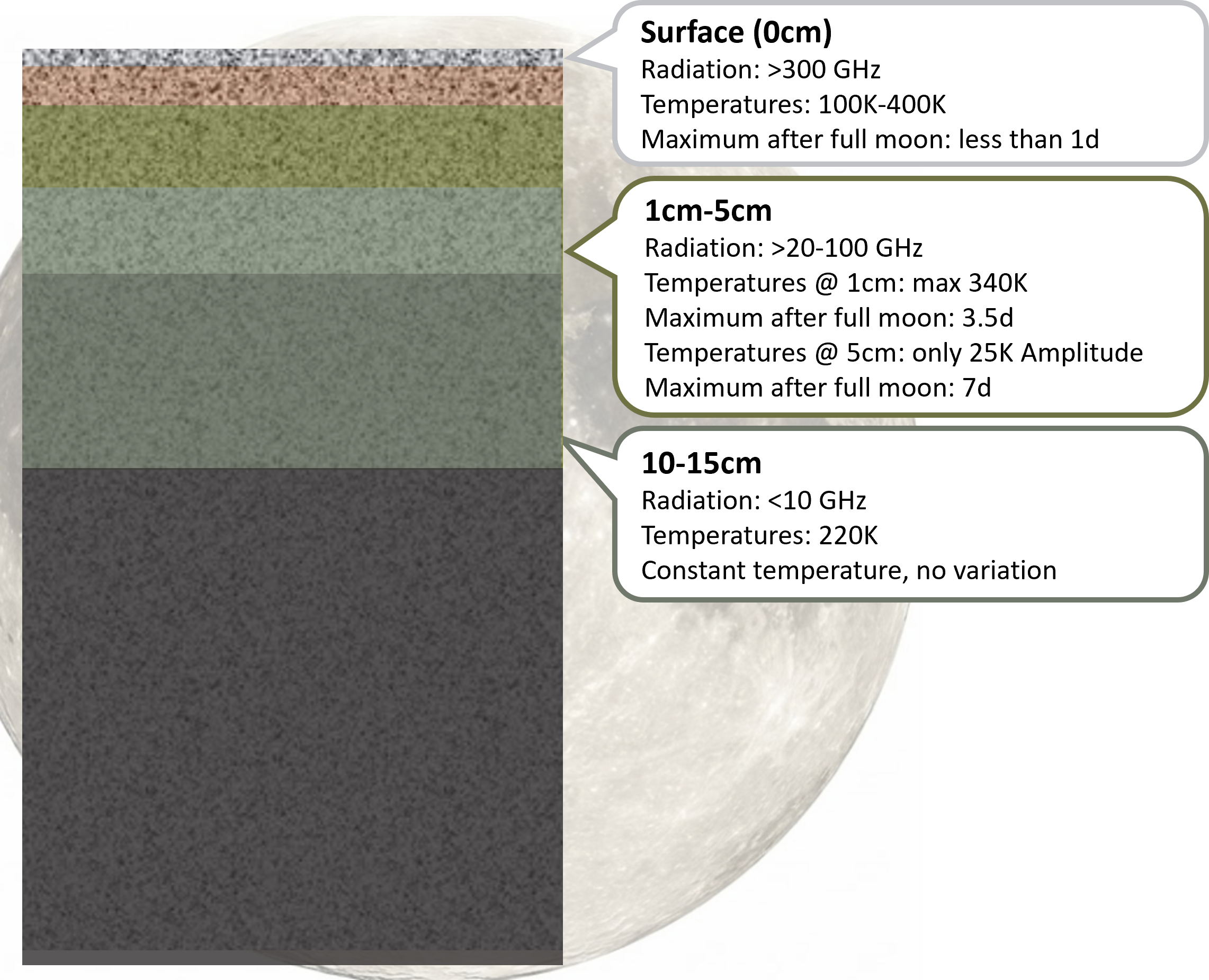
Frequency-Dependent Penetration Depth
A key property of lunar radio emission is that the penetration depth of radio waves depends on wavelength:
- The lower the observing frequency (longer wavelength),
- the deeper the radio waves penetrate into the lunar regolith
This leads to a layered view of the Moon:
Surface Layer (< 1 cm, >300 GHz)
- Strong temperature variations: 100–400 K
- Very fast response to solar illumination
- Maximum temperature occurs almost immediately after full Moon
Intermediate Layer (1–5 cm, 10–100 GHz)
- Reduced temperature variations
- Noticeable thermal delay
- Maximum temperature occurs about 3–5 days after full Moon
Deep Layers (>10 cm, <10 GHz)
- Nearly constant temperature: ~220 K
- No significant monthly variation
- Represents a thermally stable environment
Measurements (March 2026)
Measurements of the lunar brightness temperature were carried out in March 2026 using:
- a 1-meter dish
- the Second Receiver
- a bandwidth of 50 MHz
Observations were performed at:
- 10.665 GHz (Ku-band)
- 20.165 GHz (Ka-band)
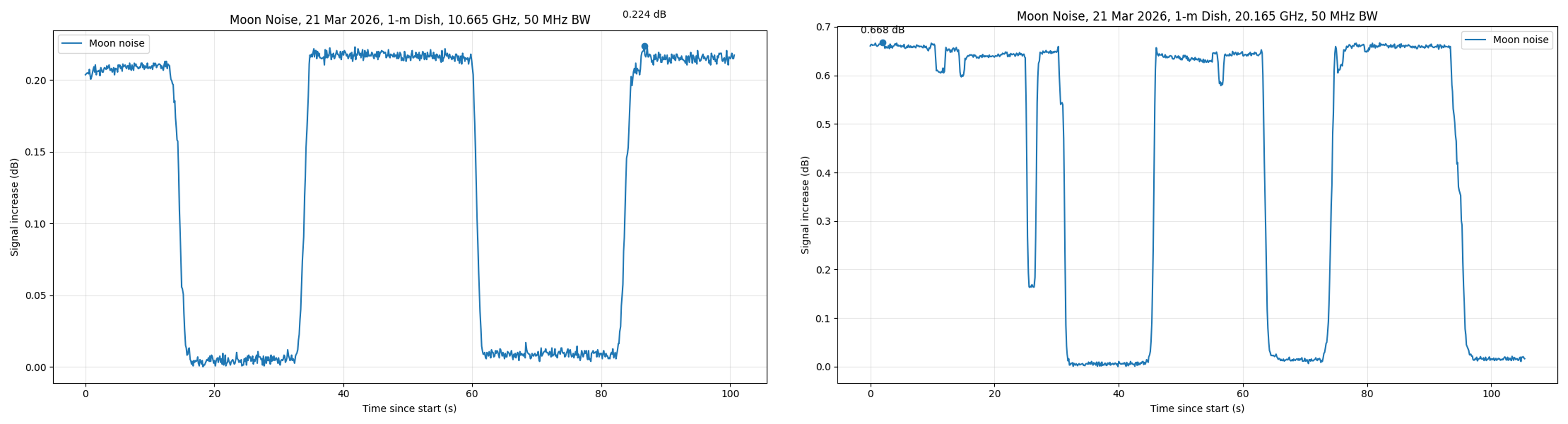
The following system temperatures were measured:
- Ku-band: \(T_{\text{sys}} \approx 219 \ \text{K}\)
- Ka-band: \(T_{\text{sys}} \approx 156 \ \text{K}\)
From these data, the following lunar brightness temperatures were derived:
- Ku-band: ~159 K
- Ka-band: ~176 K
Interpretation
The results clearly demonstrate the frequency dependence of lunar radio emission:
- At lower frequencies (Ku-band), the telescope probes deeper layers of the regolith, which are thermally more stable and therefore cooler.
- At higher frequencies (Ka-band), the emission originates from shallower layers, which are more strongly influenced by solar heating and therefore exhibit higher temperatures.
Thus, radio observations provide a unique way to study the thermal structure beneath the lunar surface, which is not accessible in optical wavelengths.
The relatively low absolute temperatures measured in this experiment can also be explained by the timing of the observations.
The measurements were carried out a few days after new Moon, a phase in which the radio emission of the lunar surface is close to its minimum. During this period, large parts of the observed surface have not yet been significantly heated by solar radiation, resulting in lower brightness temperatures.
In addition, the value derived in the Ku-band appears comparatively low. This may indicate:
- Measurement uncertainties (e.g. calibration errors, baseline effects)
- Residual systematic effects in the setup
- or environmental influences such as atmospheric conditions or RFI
These factors require further investigation in future measurements.
Overall, this highlights an important aspect of lunar radio observations:
The measured brightness temperature is not only frequency-dependent, but also strongly influenced by the lunar phase and observational conditions.
Mapping the Moon
The final image shows a radio map of the Moon in the Ku-band.
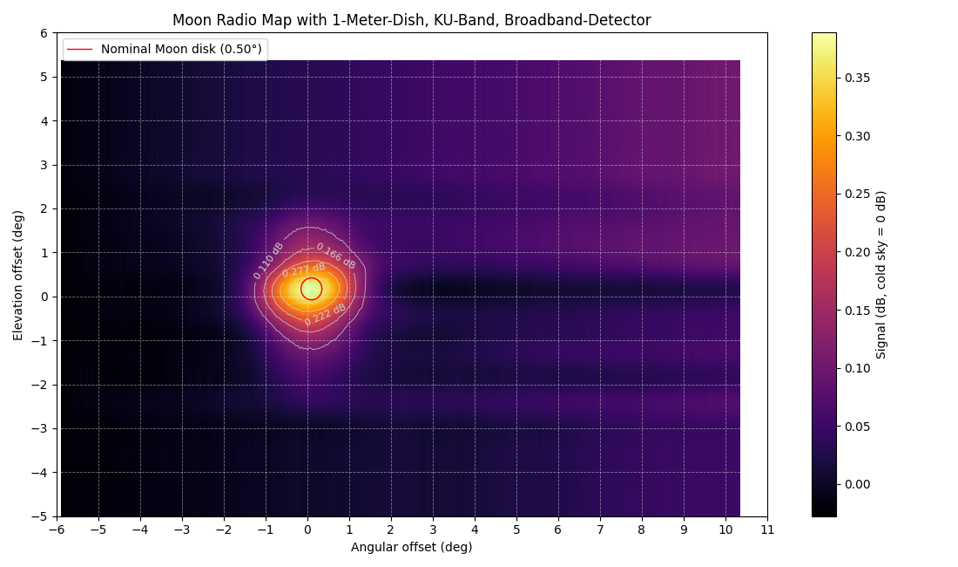
For this observation:
- The region around the Moon was scanned line by line
- The collected data were subsequently processed into a two-dimensional image
The resulting map clearly reveals:
- The lunar disk
- The antenna beam pattern
- Subtle intensity variations across the field
This demonstrates that even small amateur radio telescopes are capable of producing spatially resolved radio images of the Moon, providing insight into both the instrument and the physical properties of the observed object.
Conclusion
Radio observations of the Moon allow the determination of subsurface temperatures and reveal the layered thermal structure of the regolith. By combining:
- multi-frequency observations
- continuum measurements
- and scanning techniques
it becomes possible to study not only the surface, but also the thermal behavior of deeper lunar layers — a capability unique to radio astronomy.