hline viewer
Purpose
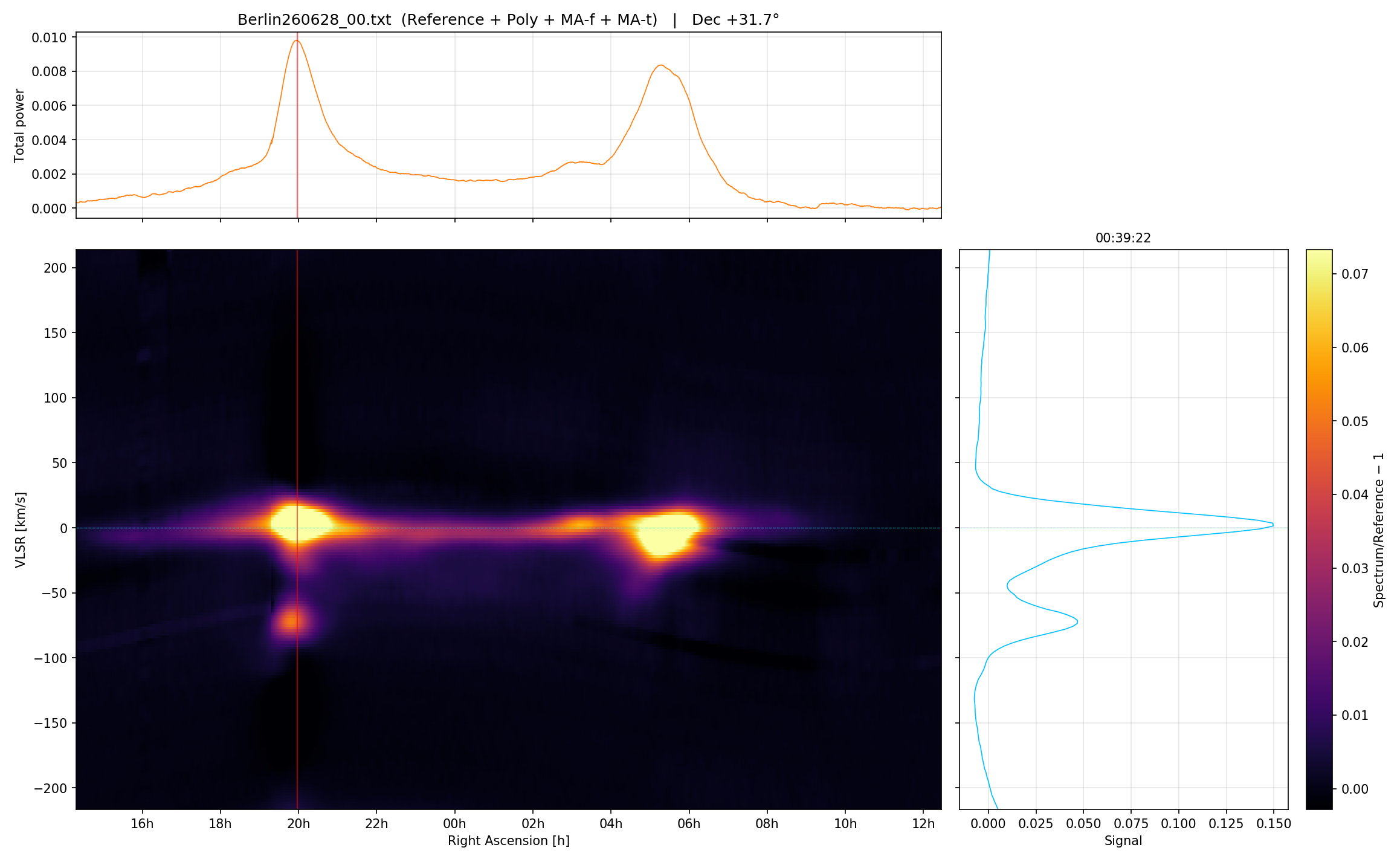
This program is a visualization and calibration tool for drift scan observations of galactic neutral hydrogen (HI, 21cm line) recorded with the ezRA software suite. It reads data files in ezRA’s specific text-matrix format and displays the recorded spectra as a waterfall diagram, allowing the user to inspect an entire observation session at a glance.
Basic Calibration
Two fundamental calibration methods are provided to remove bandpass irregularities, gain drift, and other systematic effects:
- Reference spectrum method — a user-selected spectrum (ideally from a time with little or no hydrogen signal) is used as a bandpass reference.
- Edge division — the line-free edges of the band are used as a reference to normalize out broadband variations.
New Features
- Polynomial fitting — an extension of the edge-reference method that fits a polynomial along the time axis to further reduce irregularities and drift over the course of an observation.
- RFI line removal — detection and removal of narrowband radio-frequency interference lines from the spectra.
- Dynamic averaging — manually adjustable averaging along both the frequency and time axes, used to reduce noise and make weak hydrogen signals more clearly visible.
- Flexible horizontal axis — the time axis can be displayed in UTC or converted to Right Ascension (RA).
- Flexible vertical axis — the frequency axis can be displayed as raw frequency, as radial velocity, or — using Astropy (which may require an internet connection to fetch supporting data) — as radial velocity relative to the Local Standard of Rest (LSR).
- Power and single-spectrum views — display of total power over time, as well as individual spectra extracted at a specific point in time.
Note
This program relies on a number of Python libraries (e.g. NumPy, Matplotlib, and optionally Astropy for LSR velocity conversion) which may need to be installed before first use. A sample file is included in the folder for testing — a 24-hour drift scan of the Milky Way at a declination of approximately 32°, recorded on 2026-06-28.