Meteor Scatter
Every year around August 12th/13th, Earth crosses the path of the comet Swift-Tuttle during its orbit around the sun. In the process, tiny dust particles distributed along this path enter the Earth’s atmosphere at high speeds. There, they burn up and create glowing trails in the sky. During this time, an especially high number of shooting stars appear. This meteor shower is known as the Perseids.
While the Perseids are the most popular meteor shower, there are many more throughout the year. We all enjoy sitting outside on a warm summer night and enjoying the spectacular view when a meteor burns up in our atmosphere. But what about winter or during the daytime? How many meteors are over Western Europe? Luckily, we have radio astronomy and can use radar to detect these meteors.
How Does Meteor Observation with Radio Astronomy Work?
The principle of meteor observation with radio astronomy is actually quite simple. Upon entering the Earth’s atmosphere, meteors leave behind highly ionized trails at an altitude of approximately 80 to 120 kilometers. These act like mirrors for radio waves.
Unlike shortwave and mediumwave ranges, radio waves in the VHF (UKW) range are not reflected by the ionosphere. Therefore, only transmitters located within the line of sight of the horizon, or just behind it, can be received. If a transmitter is located far behind the horizon, its signals cannot be received directly by us. However, if its radio waves hit a meteor trail in the sky, they are briefly reflected and registered as a clear signal at the receiver, even hundreds of kilometers away.
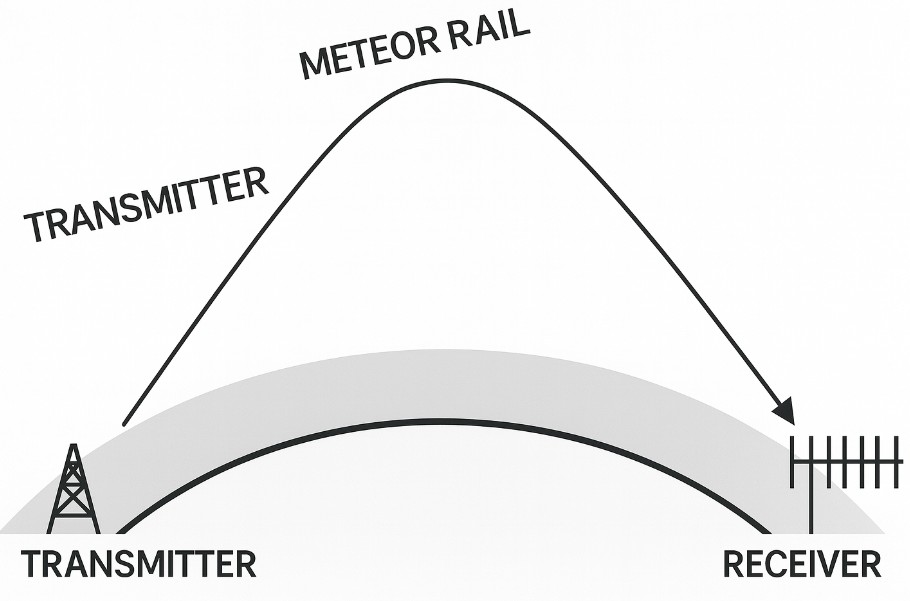
For observation, a receiver is tuned to the frequency of a constantly broadcasting radio station. We use a military transmitter (GRAVES at 143.050 MHz) near Dijon, France.
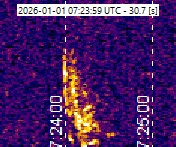
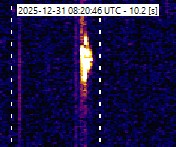
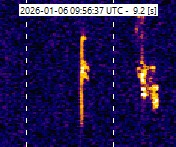
It broadcasts a continuous CW signal (a simple tone signal, like Morse code but without interruptions) into the sky and is actually intended for military purposes. Its goal is to detect and track satellites in low Earth orbit. However, it’s not just flight objects that reflect the signals of this radar, but meteor trails as well. Under normal circumstances, the GRAVES signal cannot be heard in Berlin. But if a reflection occurs on a meteor trail, the reception level rises abruptly. For a moment (in some cases up to several seconds), the tone of the radar can then be heard. These events appear in the waterfall diagram as bright lines or spots—the radio signature of a shooting star.
The Setup
For radio meteor observation at the Radio Science Institute, a directional antenna for the 2-meter band is used—specifically, a Diamond A-144S5R Yagi antenna with five elements. The antenna is connected to the receiver via a 50-ohm coaxial cable. The receiver used is a Software Defined Radio (SDR) of the type SDR-Play RSP1B, which digitizes the received signals and transmits them to the computer. Other SDR types would work just as well. For visualization, the SDR software HDSDR was used, which displays a waterfall diagram and thus makes the typical signatures of meteor reflections visible.
In order to automatically count and analyze we use the Radiometeordetector from Radio Meteor Observing Bulletin. This windows program connects itself to the SDR program and anyse the stream in real time. We update these images here every minute, so when the system is up and running you should see live data here.
Live Data
If you want to add major meteor shower events to your calender please use these Calendar entries.
Monthly
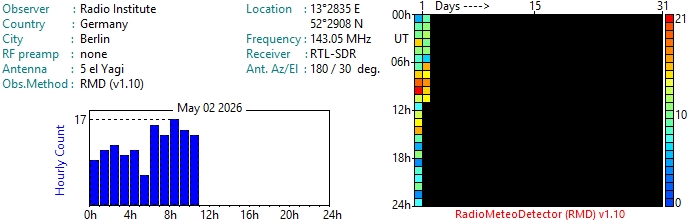
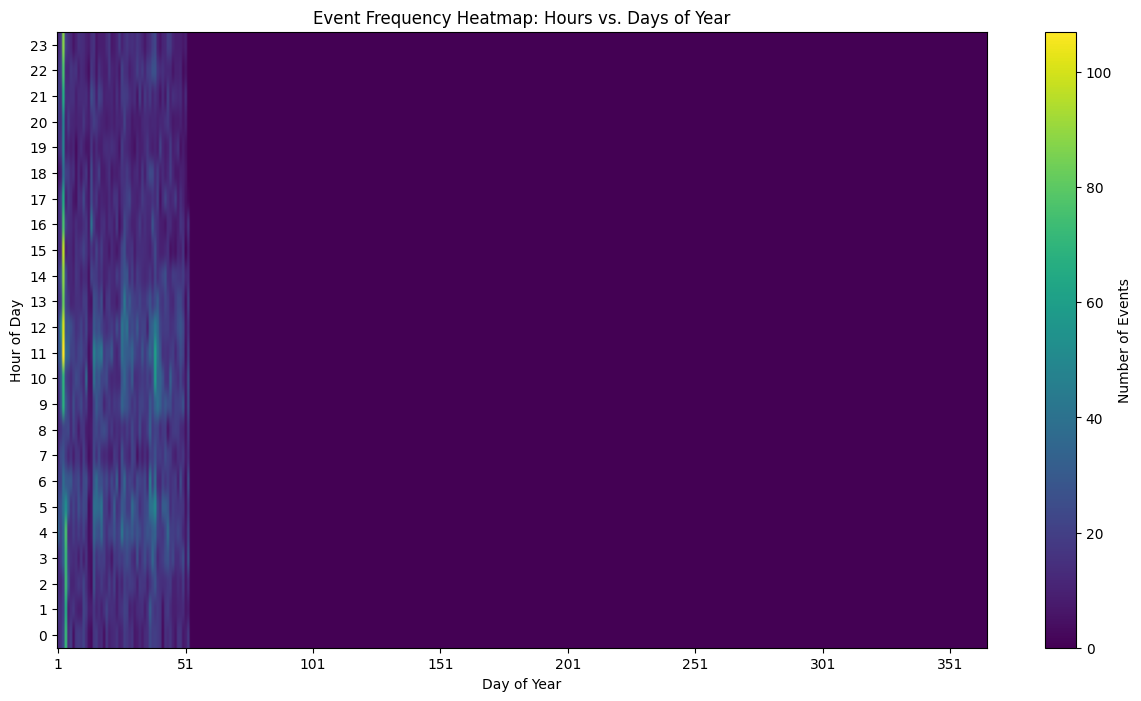
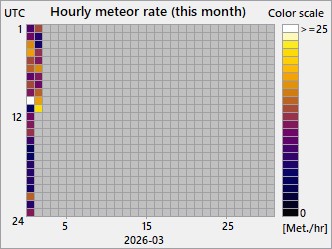 Let’s start with the big overview. This is the current month day by day and hour by hour with colour indicating the amount of detected meteorides. As we can see the most meteriods are in the morning.
Daily
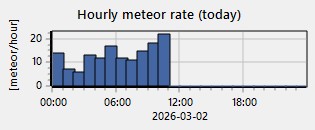
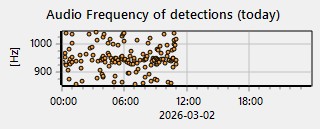
Let’s drill down to the current day. These graphes shows the current day in more detail. On how many Meteriods we detected and also what was the center audio frequency. So in this case we know the direction.
Hourly
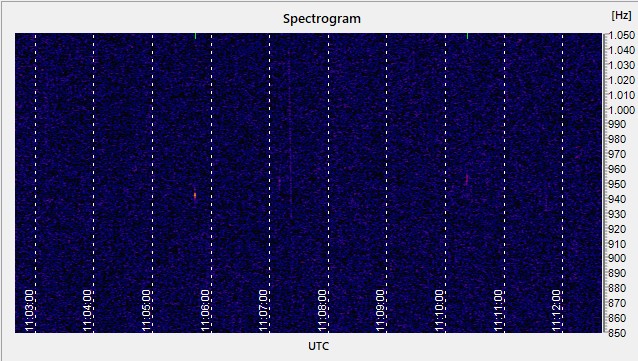
If we want to have a more detailed view, lets have a look at the spectrogram for the last hour. Here we can see everything, not only the detected meterids but also Satellites and Planes.
Event
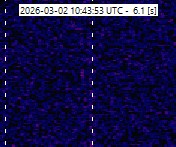
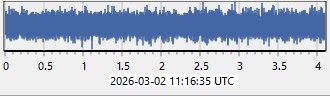
And here a zoom into the last detected meteor, to see more details.
Summary
RMOB offers a nice image updated every hour to embed in homepages. But the software itself generates different detailed images every hour. So let’s have a look.
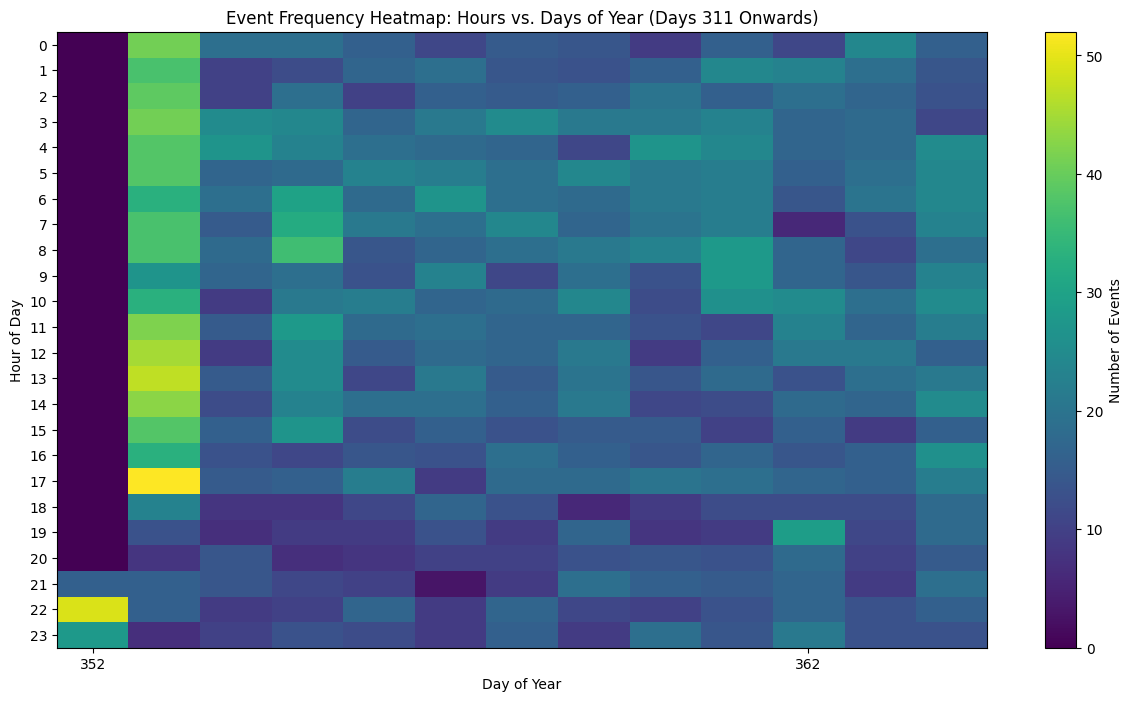
Historical Data
Different Signatures in the Waterfall Diagram
When looking at a waterfall diagram, various signatures can be recognized that point to different objects and movement patterns. These patterns are created by the Doppler effect: signals above the transmission frequency of 143.050 MHz are moving toward us, while signals below it are moving away from us. We having a look here on the SDR itself to see the signal in more details.
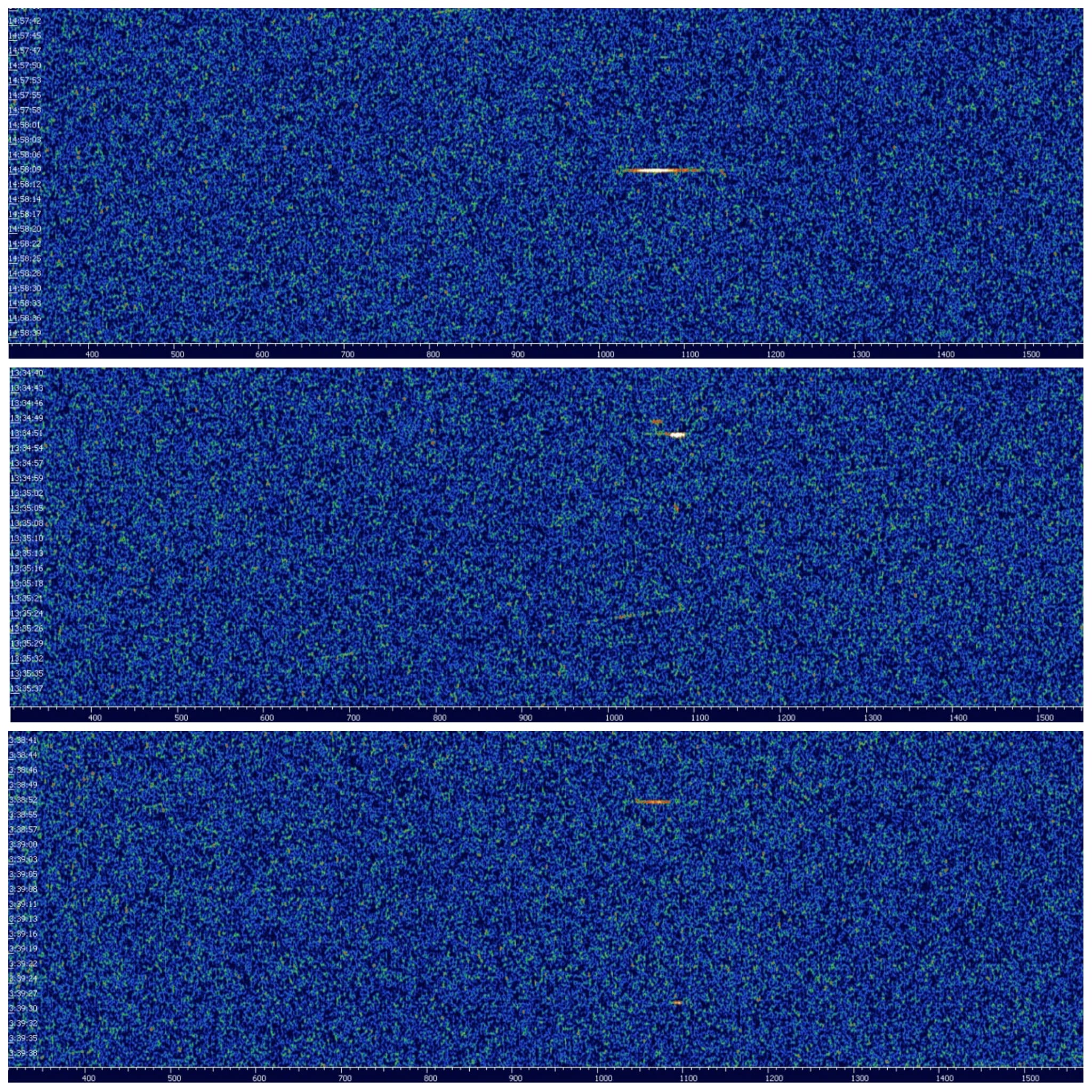
Small and Medium Meteors (Underdense Meteors): These appear as horizontal lines above 143.050 MHz. They enter the atmosphere at very high speeds and move rapidly toward us. The change in relative velocity—the velocity vectors—is large, leading to this horizontal pattern. Most meteors form such horizontal underdense trails and are very bright.
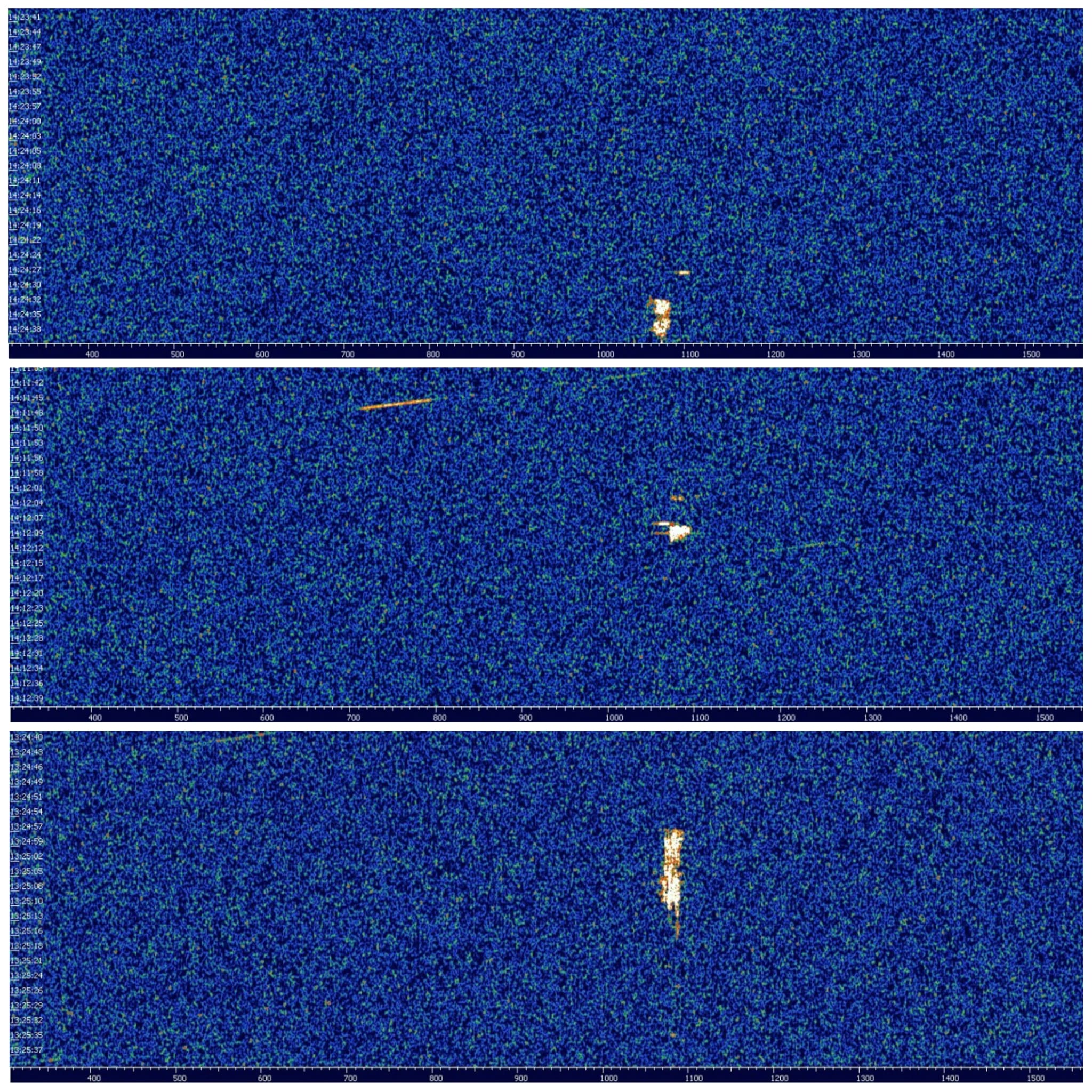
Larger Meteors (Overdense Meteors): These can penetrate deeper into denser layers of the atmosphere, are slowed down, and ignite. Due to the higher electron density in the plasma of the ionization trail, the entire radio wave is reflected. This often appears in the diagram as a bright, vertical cluster. Most visible meteors (“shooting stars”) are overdense meteors.
Airplanes: These, by contrast, move relatively slowly. Their relative speed changes very little, resulting in vertical lines. However, when observing the GRAVES transmitter from Berlin, airplane signatures are rarely or never seen because the transmitter is too far away and the planes fly too low.
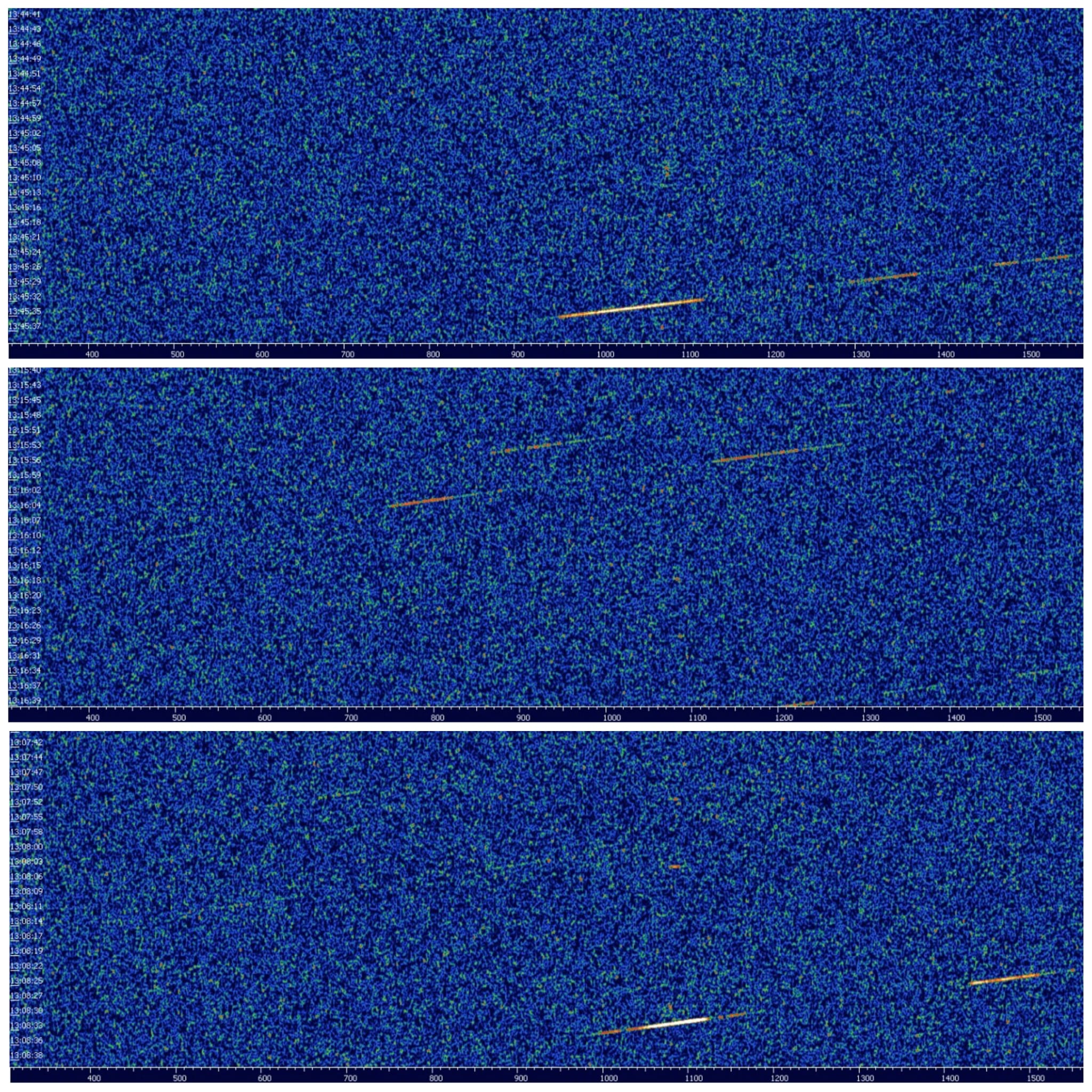
Satellites: In terms of velocity change, satellites lie between meteors and airplanes. Their flight altitude is much higher, which is why they can be seen from Berlin. Their trails appear diagonal—in our case, from the top right to the bottom left. Initially (above 143.050 MHz on the right side), they move toward us, then (below 143.050 MHz on the left side) away from us.
How does it sound?
The signal from GRAVES is a constant signal but how would it sound if we transform the signal to noice and use the doppershift. Here is one example of 3 days meteor shower cutted together, so you could here all the meteors for 3 days in ~30 seconds.
Clasification
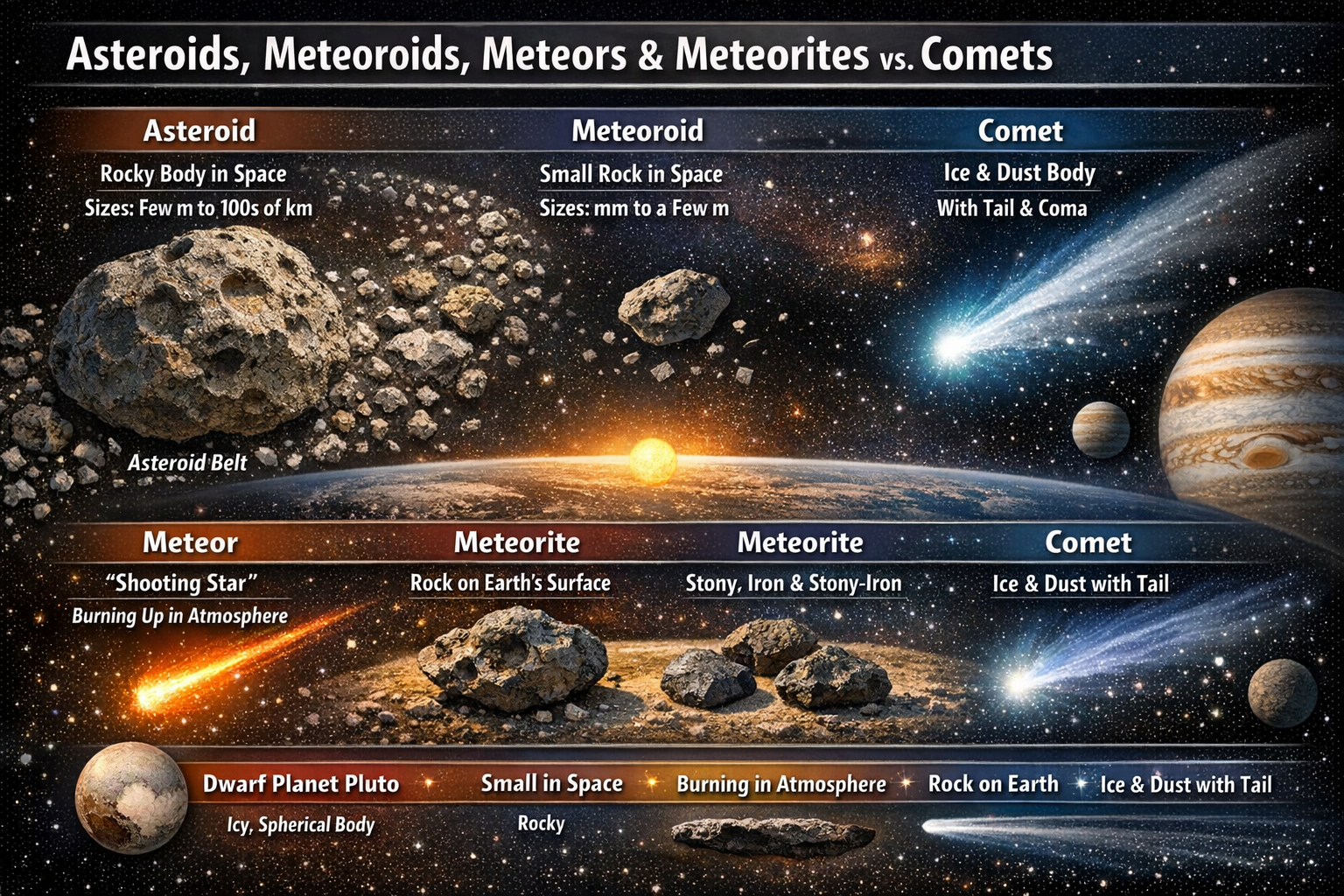
1. Asteroid
- Definition: Smaller, rocky, or metallic celestial bodies that mostly move in orbits around the Sun, primarily in the Asteroid Belt between Mars and Jupiter.
- Size: From a few meters to several hundred kilometers (e.g., Ceres, which is classified as a dwarf planet).
- Composition: Mostly rock and metals, with little to no ice.
2. Meteoroid
- Definition: Small chunks of rock or metal in space, significantly smaller than asteroids (ranging from millimeters to a few meters in size).
- Origin: Often fragments of asteroids or comets.
- Note: When they enter the Earth’s atmosphere, they become meteors (“shooting stars”).
3. Meteor (“Shooting Star”)
- Definition: The luminous phenomenon that occurs when a meteoroid enters the atmosphere and burns up.
- Size: Usually very small particles that burn up completely.
- Note: If a meteoroid is large enough to reach the ground, it becomes a meteorite.
4. Meteorite
- Definition: The surviving remains of a meteoroid that reach the Earth’s surface.
- Classification:
- Stony meteorites (most common type)
- Iron meteorites
- Stony-iron meteorites
5. Comet (“Tail Star”)
- Definition: Celestial bodies made of ice, dust, and rock that orbit the Sun in highly elliptical orbits.
- Characteristics:
- As they approach the Sun, they develop a coma (an envelope of gas and dust) and often two tails (a gas tail and a dust tail).
- They often originate from the Kuiper Belt or the Oort Cloud.
- Examples: Halley’s Comet, Comet Hale-Bopp.
Other Objects of This Type
- Dwarf Planets (e.g., Pluto, Ceres, Eris) – Similar in size to asteroids, but spherical and with their own clear orbit.
- Trans-Neptunian Objects (TNOs) – Icy bodies beyond Neptune (e.g., in the Kuiper Belt).
- Interstellar Objects – Rare visitors from other star systems (e.g., ‘Oumuamua, Borisov).
Summary of Differences
| Object | Location | Size | Composition | Distinctive Feature |
|---|---|---|---|---|
| Asteroid | Main Belt, near-Earth orbits | Meters – Hundreds of km | Rock/Metal | No tail |
| Meteoroid | Space (small chunks) | Millimeters – Meters | Rock/Metal | Becomes a meteor in atmosphere |
| Meteor | Atmosphere | Very small | Burning material | Luminous phenomenon |
| Meteorite | Earth’s surface | Remaining pieces | Rock/Iron | Scientifically studied |
| Comet | Outer Solar System | Kilometers wide | Ice + Dust | Tail when near the Sun |
Advantages and Limitations of Meteor Radio Astronomy
One of the biggest advantages of meteor observation with radio astronomy is its independence from weather: clouds, fog, or haze do not affect the measurements. Furthermore, radio astronomy can be used around the clock—meteors can be reliably registered even in broad daylight. Daylight meteor showers, in particular, can be captured this way. The method is highly sensitive and allows for the recording of a very large number of meteors due to the large field of view provided by the relatively wide antenna beam. Additionally, radio observations can be easily automated: with suitable software, events can be continuously recorded, stored, and later statistically evaluated.
Radio meteor observation also has its limits. The radiant of the observed meteor shower must be above the horizon for reflections to occur. The field of vision when using the GRAVES transmitter from Berlin is limited to an area between Spain and Ukraine. Disturbances in the ionosphere, such as Sporadic-E, can make observation difficult in rare cases. Since only a random point along the path of a meteor is captured, no reliable statement about maximum brightness can be derived from the radio signals. Similarly, an absolute determination of the meteor rate is not possible because the reception characteristics of a directional antenna are very complex. There is also a bias in favor of fast meteors, as slow particles often do not ionize the air sufficiently. In simple forward-scatter setups, the position of individual meteors cannot be precisely determined; this would require cross-bearing (triangulation).
Despite these limitations—some of which also occur in optical astronomy—the mentioned advantages make meteor radio astronomy an indispensable supplement to optical observation.