Andromeda Galaxy M31
Andromeda Galaxy (M31)
The Andromeda Galaxy (M31) is the largest member of the Local Group, the galaxy cluster that also includes our own Milky Way. At a distance of approximately 2.5 million light years, it is the nearest large spiral galaxy and is moving toward the Milky Way due to gravitational attraction.
Despite its enormous physical size, Andromeda appears faint from Earth. Its apparent angular diameter extends up to 190 arcminutes, corresponding to roughly six times the size of the full Moon or the Sun. However, because of its great distance, its surface brightness is very low, making it barely visible to the naked eye under good conditions. The same applies to its radio emission, which is extremely weak and therefore difficult to detect.
Like the Milky Way, Andromeda contains large amounts of neutral hydrogen distributed throughout its spiral arms. Due to its motion toward us, the hydrogen line is significantly shifted by the Doppler effect. Under favorable conditions, this shift makes it possible to detect the galaxy even with relatively small radio telescopes.
Instrumentation
The observations were carried out using a compact amateur setup consisting of a 1.8-meter satellite dish, a loop feed for 1420 MHz (RF Hamdesign), and an Airspy SDR receiver. Data acquisition and processing were performed using SDR# (SDR Sharp) together with the IF Average plugin, enabling long integrations and stable spectral measurements.
Observational Method
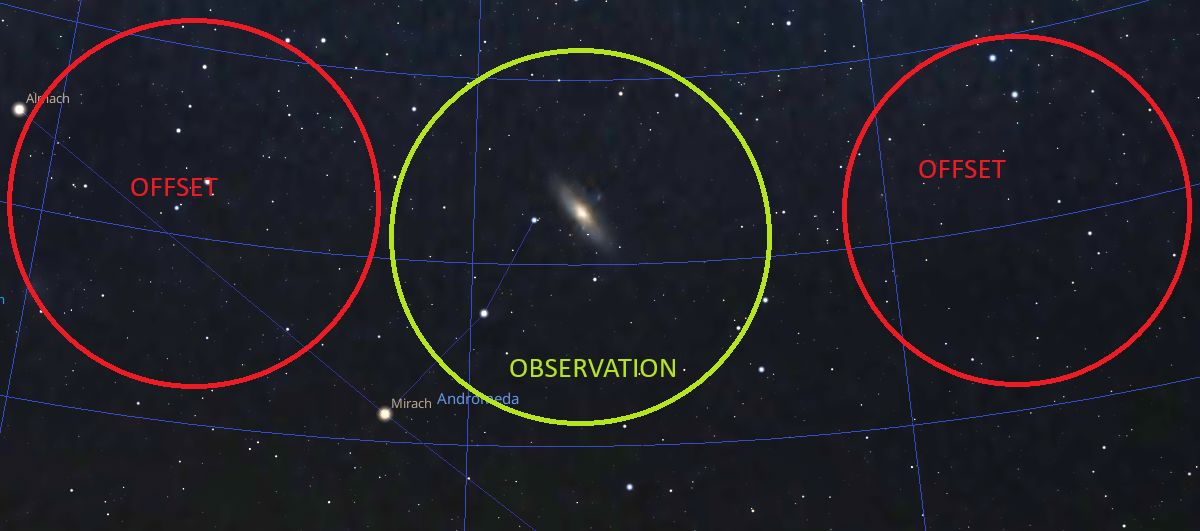
The antenna was precisely aligned to the declination of the Andromeda Galaxy, allowing the source to drift through the beam during Earth’s rotation. To isolate the weak extragalactic signal from the much stronger local hydrogen emission of the Milky Way, a differential measurement strategy was applied.
A 60-minute integration was recorded before the transit of M31 and another 60-minute integration after the transit. These two measurements were averaged to form a baseline. A further 60-minute integration was then recorded during the transit itself. By subtracting the averaged baseline from the transit measurement, the contribution of local hydrogen emission and instrumental effects was significantly reduced.
Results and Interpretation
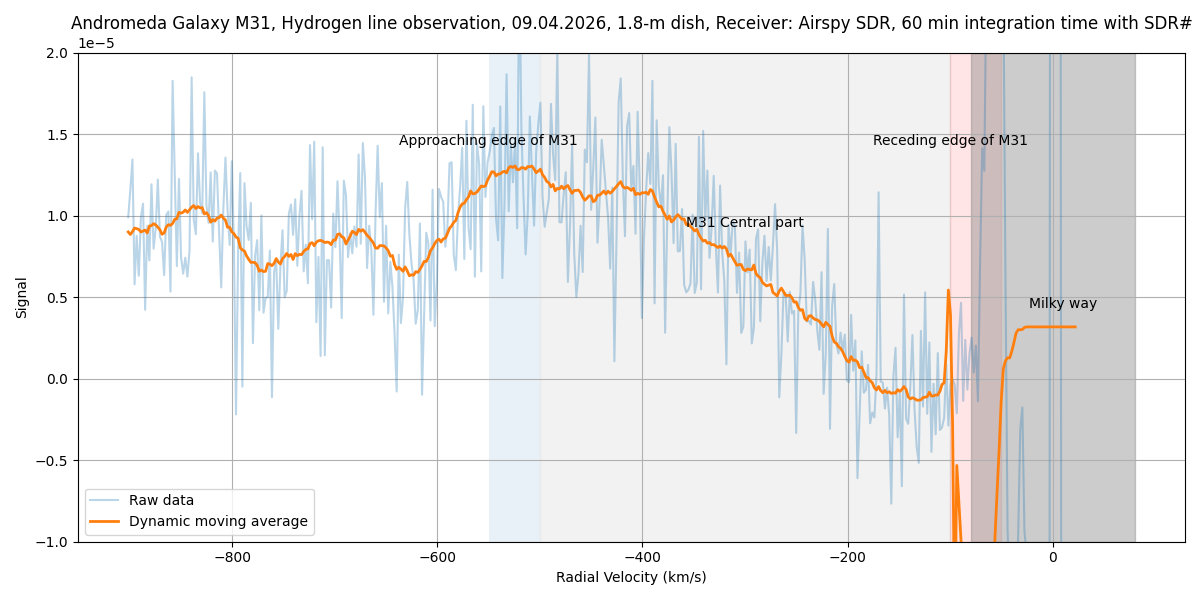
The resulting spectrum shows a clear signal enhancement at approximately −525 km/s. This value is consistent with the expected radial velocity of the outer regions of Andromeda that are rotating toward us.
Due to the internal rotation of the galaxy, one side appears to move toward the observer while the opposite side moves away. At the same time, the entire galaxy is approaching the Milky Way. The combination of these velocity components leads to a strong shift of the approaching side toward negative velocities.
In contrast, the emission from the receding side is shifted closer to the velocity range of local Milky Way hydrogen and is therefore largely masked by the much stronger foreground emission. This makes it difficult to detect the full velocity structure of the galaxy.
Outlook
The results demonstrate that even weak extragalactic hydrogen signals can be approached with relatively simple equipment. However, a reliable confirmation of the detection requires repeated observations.
Multiple measurements are necessary to reduce noise, identify systematic effects, and ensure that the observed signal is consistently present at the expected velocity. Only through such repetition can spurious features be excluded and the detection be considered robust.