Extragalactic sources: Cygnus A
While supernova remnants are well-known sources of continuum radio emission within our Galaxy, there also exist powerful radio sources located far beyond the Milky Way. These are known as radio galaxies.
Radio galaxies are associated with active galactic nuclei (AGN), where a supermassive black hole at the center of a galaxy accelerates matter into relativistic jets. These jets emit strong synchrotron radiation, which can be detected across a wide range of radio frequencies.
One of the most prominent examples is Cygnus A, located in the constellation Cygnus.
- Distance: ~750 million light-years
- Flux density: ~1500 Jy at 1420 MHz
- One of the brightest extragalactic radio sources in the sky
Like most active galactic nuclei, Cygnus A exhibits a steep radio spectrum, meaning that its flux density decreases significantly at higher frequencies. Therefore, observations at lower frequencies (L-band) are much more favorable.
Observations (Berlin, August 2024)
Between 12 August and 30 August 2024, Cygnus A was observed using a 1.8-meter dish under urban conditions in Berlin.
Instrumentation
- 180 cm C-band satellite dish
- Loop feed for 1420 MHz (RF Hamdesign)
- Nooelec Sawbird+ H1 LNA
- RTL-SDR (NESDR Smartee)
- Data acquisition: ezCol (ezRA suite)
- Data processing: Excel (integration and averaging)
The observing frequency was set to 1425.1 MHz, slightly offset from the hydrogen line to avoid contamination from galactic HI emission.
Measurement Strategy
A long-term drift scan was performed at a fixed pointing:
- Azimuth: 200°
- Elevation: 78°
A total of 19 transits were recorded over multiple days.
Even in the first measurement, a weak signal peak was visible at the expected transit time of Cygnus A, despite significant interference (e.g. from nearby electronic devices).
A key confirmation came from the daily repetition of the signal, with the peak occurring 4–5 minutes earlier each day, consistent with the sidereal motion of astronomical sources.
Results and Signal Extraction
Individually, the transit curves show only a very weak signal. However, by combining and averaging multiple observations:
- The signal becomes progressively clearer
- Noise is significantly reduced
- The characteristic transit shape emerges
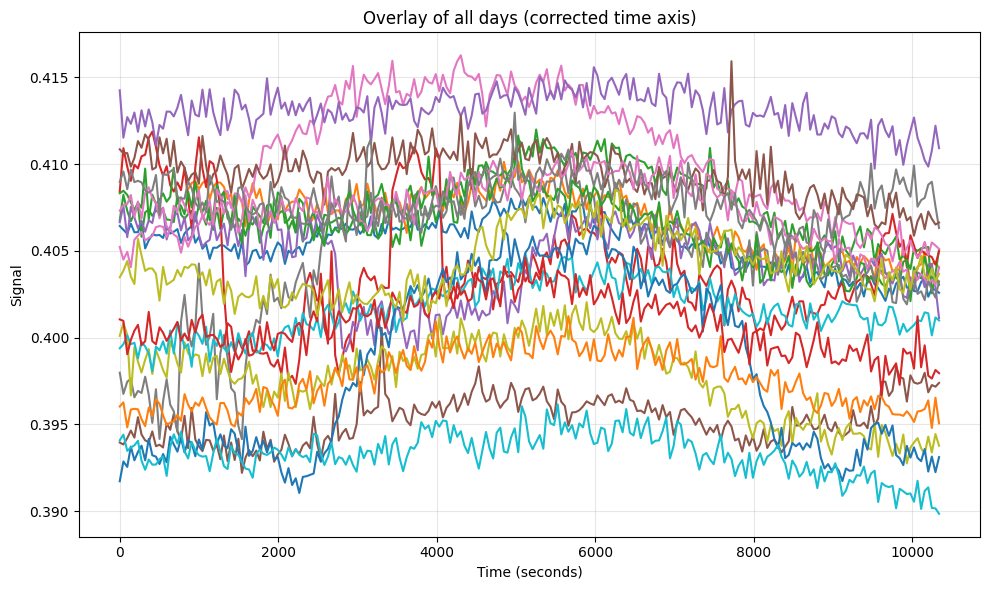
The first figure shows all individual transit curves overlaid.
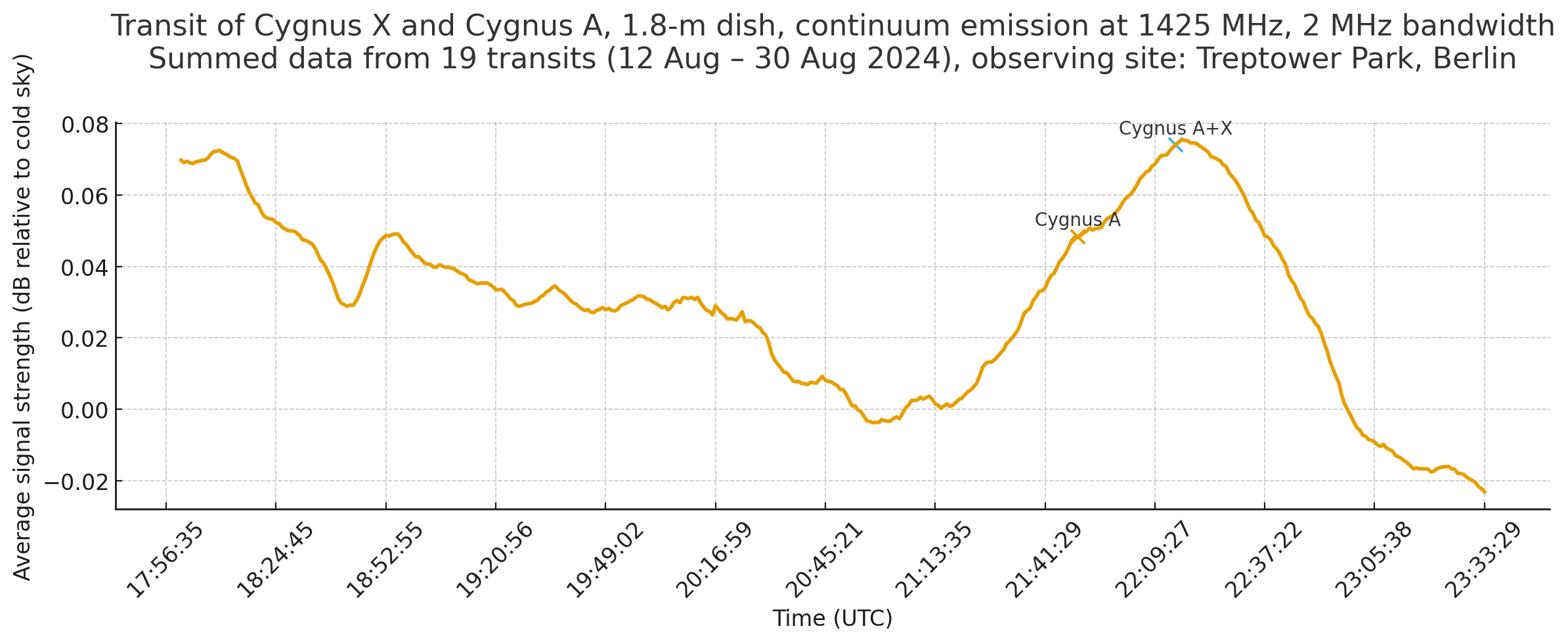
The second figure shows the averaged transit curve, obtained by combining all measurements.
The original integration time per measurement was 26 seconds, followed by additional averaging during data processing.
Cygnus A and Cygnus X
The resulting averaged curve reveals not only Cygnus A, but also the nearby source Cygnus X:
- Cygnus A: compact, bright radio galaxy (point-like source)
- Cygnus X: extended star-forming region (~10–12° in size)
The two sources are separated by only ~4°.
With a beamwidth of approximately 9° (for a 1.8 m dish at 1425 MHz):
- Both sources are partially blended
- Cygnus A appears as a small bump
- The broader structure is a product of Cyg A and Cyg X together, but dominated by Cygnus X.
Although Cygnus A has a higher intrinsic brightness, Cygnus X contributes significantly due to its large angular extent.
Verification of Detection
Several factors confirm the successful detection of Cygnus A:
- Correct transit timing and daily shift
- Consistent signal shape across multiple observations
- Agreement with expected beamwidth
- Improved visibility through integration and averaging
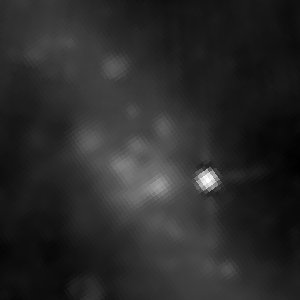
The third image shows a radio map of the Cygnus region (Cygnus A and X, from the Allsky Survey 408 MHz, downloadable from the website SKYVIEW (https://skyview.gsfc.nasa.gov/)), where both Cygnus A and Cygnus X are clearly visible.
Conclusion
This experiment demonstrates that even extragalactic radio sources at distances of hundreds of millions of light-years can be detected with relatively simple amateur equipment.
Key factors for success include:
- Long-term observations
- Careful calibration and pointing
- Extensive averaging of multiple transits
Despite strong interference and extremely weak signals, the detection of Cygnus A highlights the remarkable potential of amateur radio astronomy to explore not only our Galaxy, but also the distant universe.