Objects
On the following pages, we present observations of various continuum radio sources.
We have already discussed the radio brightness (flux density) of different radio sources in the sky. In that context, we introduced the distinction between thermal and non-thermal radio sources.
A key difference between these two types is their dependence on observing frequency:
- Thermal radio sources become brighter at higher frequencies (shorter wavelengths)
- Non-thermal radio sources become brighter at lower frequencies (longer wavelengths)
Thermal Radio Sources
Thermal radio sources are primarily found within the solar system. They are dominated by the Sun and the Moon. These are the strongest natural radio sources in the sky and therefore ideal targets for amateur radio astronomy.
- Figure 1 shows a transit of the Sun in the Ku-band at 10.665 GHz with a bandwidth of 50 MHz.
- Figure 2 shows a transit of the Sun in the Ka-band at 21.5 GHz without bandwidth limitation.
- Figure 3 shows a transit of the Moon in the Ku-band at 10.665 GHz with a bandwidth of 50 MHz.
- Figure 4 shows a transit of the Moon in the Ka-band at 21.5 GHz without bandwidth limitation.
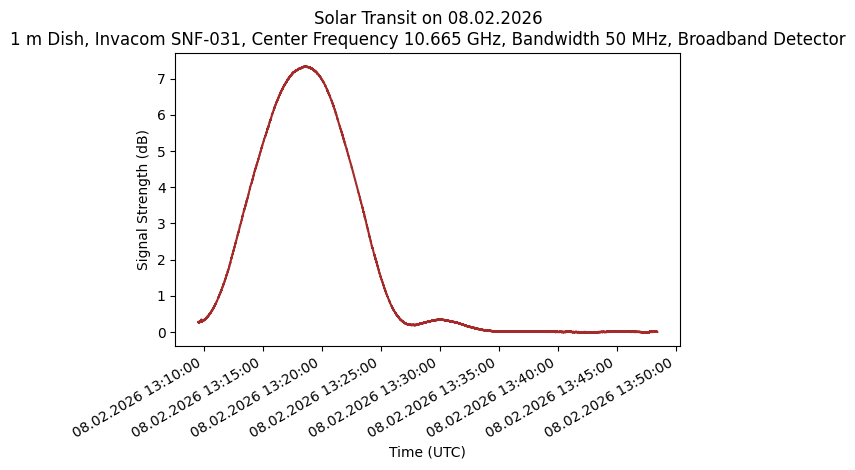
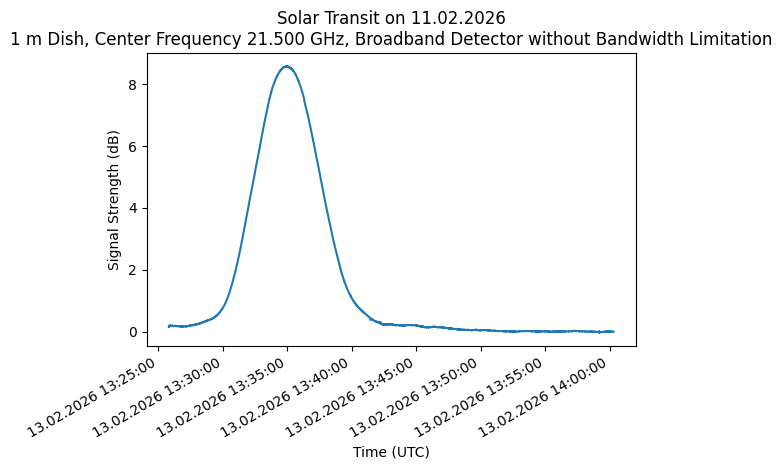
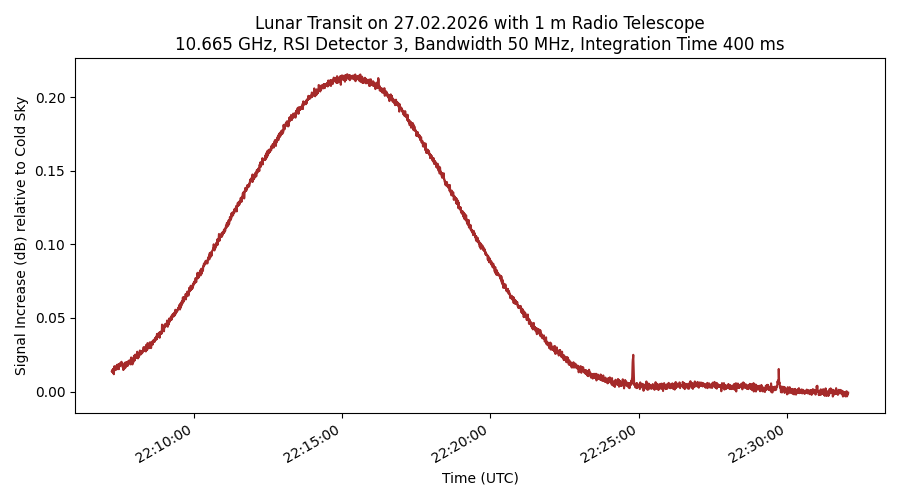
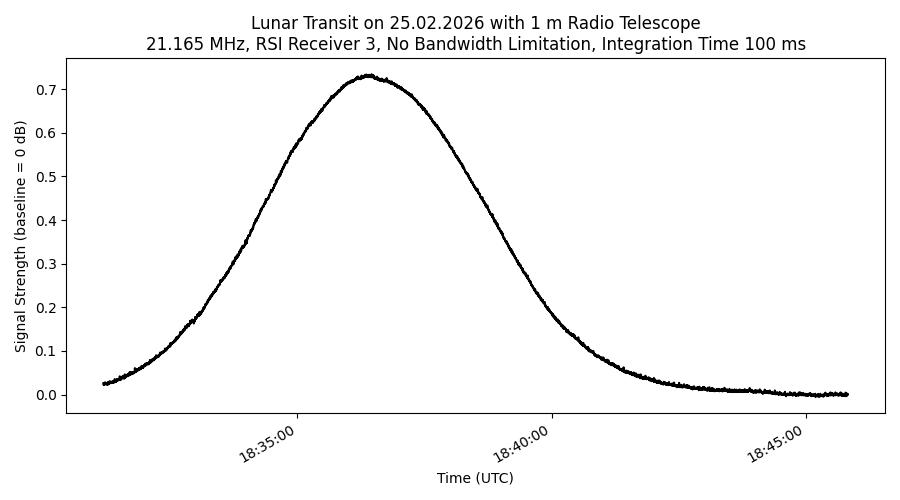
The transit curves can be used to draw some interesting conclusions about the source, its radio brightness, and its shape and size. Furthermore, transit curves provide indications of the radio telescope’s sensitivity and resolving power. In addition, a radio telescope can be used to determine the surface temperature of thermal emitters. The corresponding measurements can be found here:
The planets are also thermal emitters. However, under typical amateur conditions:
- Venus is propably the only object (besides Sun and Moon) that can be observed
- Other planets are either
- too far away
- too cold
- or, in the case of Mercury, too close to the Sun
- too far away
Special Case: Jupiter
A special case is Jupiter, which is not only a thermal emitter but also produces strong non-thermal radio emission.
- This emission is generated by Jupiter’s intense magnetic field
- It occurs in the form of bursts rather than continuous radiation
- It is observable only at very long wavelengths (~20 MHz, decameter range)
These observations are not covered here, but are part of the Radio Jove project
Non-Thermal Emission from the Sun
The Sun also produces non-thermal radio emission at lower frequencies, originating from strong magnetic fields in the solar atmosphere.
These phenomena are studied in the e-Callisto project
Non-Thermal Radio Sources
The most important non-thermal radio sources fall into two main categories:
- Supernova remnants within our Galaxy
- Example: Taurus A (Crab Nebula)
- Radio galaxies located far beyond the Milky Way
- Example: Cygnus A
These sources are significantly weaker than thermal emitters like the Sun and Moon, and therefore much more challenging to observe — especially with small amateur instruments.
This page provides practical examples of both types of continuum sources and demonstrates how they can be observed with relatively simple equipment.