Milky Way
The Milky Way consists of billions of stars. In between them, it is often said, there is nothing. This is not entirely correct: interstellar space is filled with hydrogen. It is extremely sparse and tenuous — on Earth we would describe it as a high vacuum. However, due to the enormous distances between the stars (the nearest star is more than 3 light years away) and the immense size of our galaxy, a significant amount of hydrogen accumulates.
This hydrogen has a remarkable property: it emits weak radio radiation. The emission originates from interactions between hydrogen atoms in the thin interstellar medium, leading to a spin-flip transition of the electron. The numbers behind this process are quite astonishing. On average, it takes about 60 years for a hydrogen atom to collide with another atom. After excitation, the atom remains in this state for about 11 million years before it decays and emits a photon with a wavelength of 21 cm (1420.405 MHz).
Because these events are so rare, the resulting radiation is extremely weak. The fact that we can observe the 21 cm emission of the Milky Way at all is due to the enormous mass of hydrogen and the vast size of the galaxy.
Since this is spectral line radiation, the Doppler effect can be used to measure frequency shifts. Because the rest frequency of neutral hydrogen is precisely known (1420.405 MHz), any observed frequency shift can be directly converted into a radial velocity. This allows us to determine the motion of hydrogen clouds relative to the observer and to study the structure and dynamics of the Milky Way.
The (non-relativistic) relation between frequency shift and radial velocity is:
\[ v_r = c \cdot \frac{f_0 - f}{f_0} \]
where
v_r = radial velocity
c = speed of light
f_0 = rest frequency (1420.405 MHz)
f = observed frequency
Using this method, astronomers such as Jan Hendrik Oort, Frank John Kerr, and Gart Westerhout were able in the 1950s to uncover the spiral structure of our galaxy.
Observing the Milky Way with a 1-Meter Dish
A satellite dish with a diameter of 1 meter is not only useful for continuum observations of the Sun, the Moon, or supernova remnants. A standard TV dish of this size is already sufficient to observe the Milky Way in the light of neutral hydrogen.
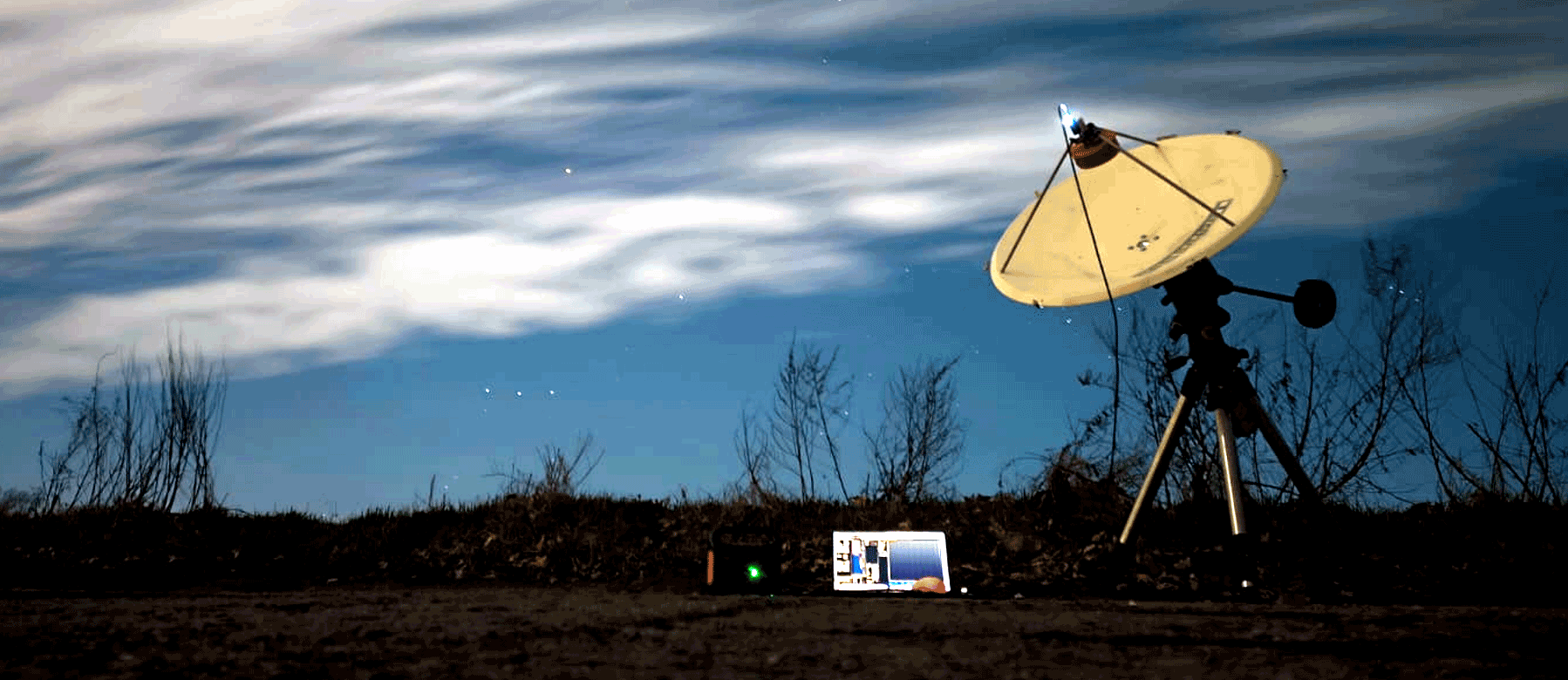
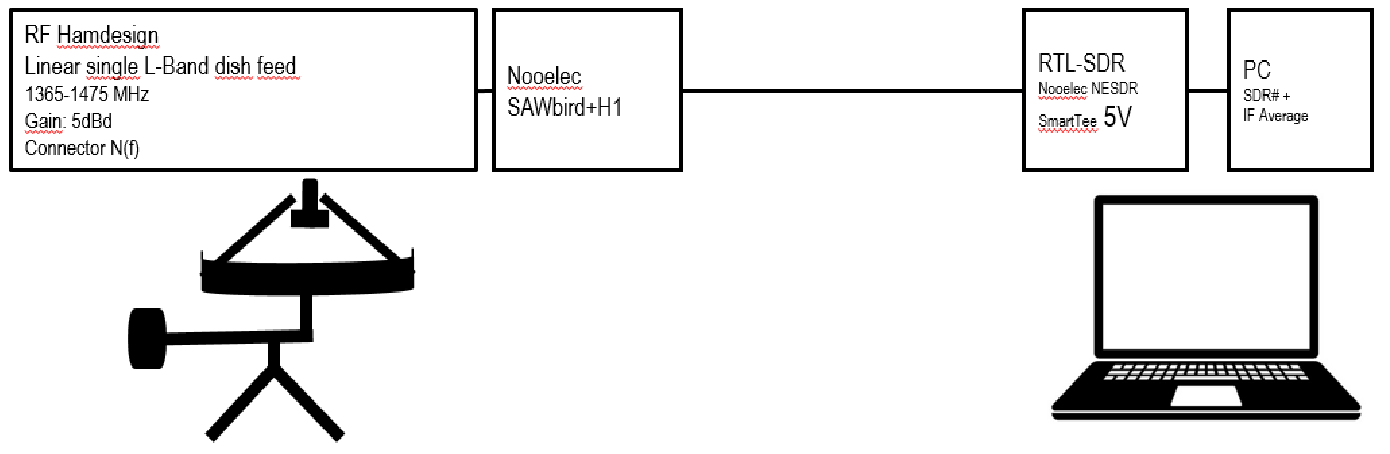
A typical setup consists of a 1420 MHz ring feed (for example from RF Hamdesign or a simple self-built version using a 21 cm copper wire, a small metal plate, and a pipe cap). Directly at the feed, a low-noise amplifier such as the Nooelec SAWbird H1 is installed. The signal is then fed via coaxial cable into an SDR receiver like the Nooelec NESDR SMArTee, which also powers the LNA via its bias-tee function.
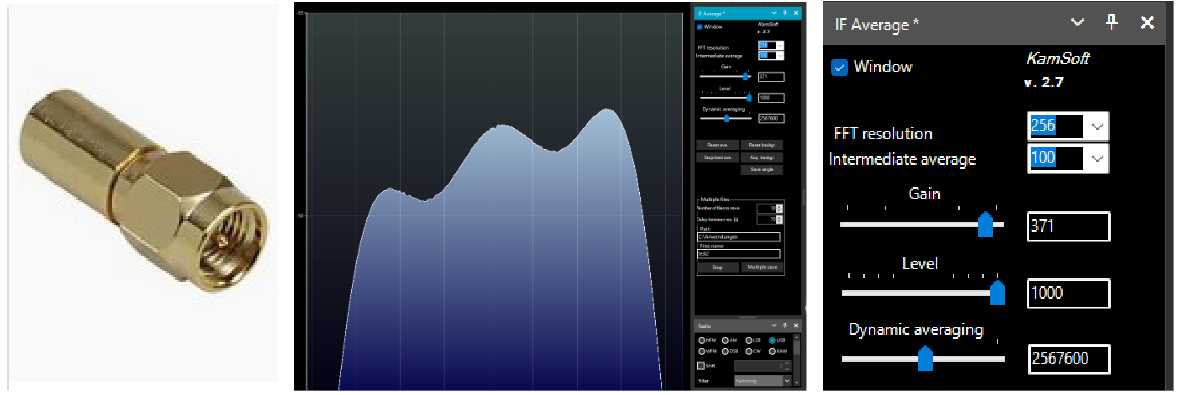
As a simple software solution, SDR# (SDR Sharp) can be used together with the IF Average plugin. This setup allows spectra to be displayed over a selected frequency range, integrated over time to improve the signal-to-noise ratio, and corrected for baseline variations caused by the receiver.
For IF Average, I use an FFT resolution of 256, an Intermediate Average of 100 and a dynamic averaging of 2.5 million (which corresponds to 250 seconds). For calibration, a background must first be recorded, which is later subtracted from the recording. This works very well with a 50 ohm terminating resistor (dummy load), which is placed in front of the LNA to record the background.
Spectra
When the antenna is pointed toward the sky, a narrowband signal appears around 1420.405 MHz. The signal becomes stronger the more precisely the antenna is aligned with the Milky Way. The spectral shape varies significantly depending on the observed direction within the galaxy.
In some regions, the signal is shifted by several kilohertz toward higher or lower frequencies. In other directions, only a single peak is visible, while in some cases multiple peaks appear. These variations are caused by different radial velocities of hydrogen clouds along the line of sight.
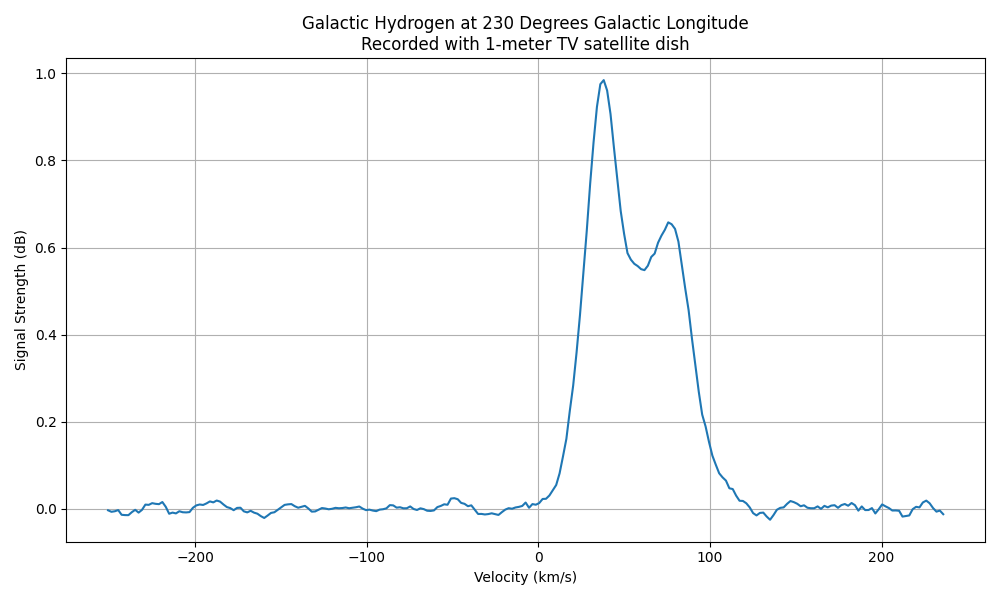
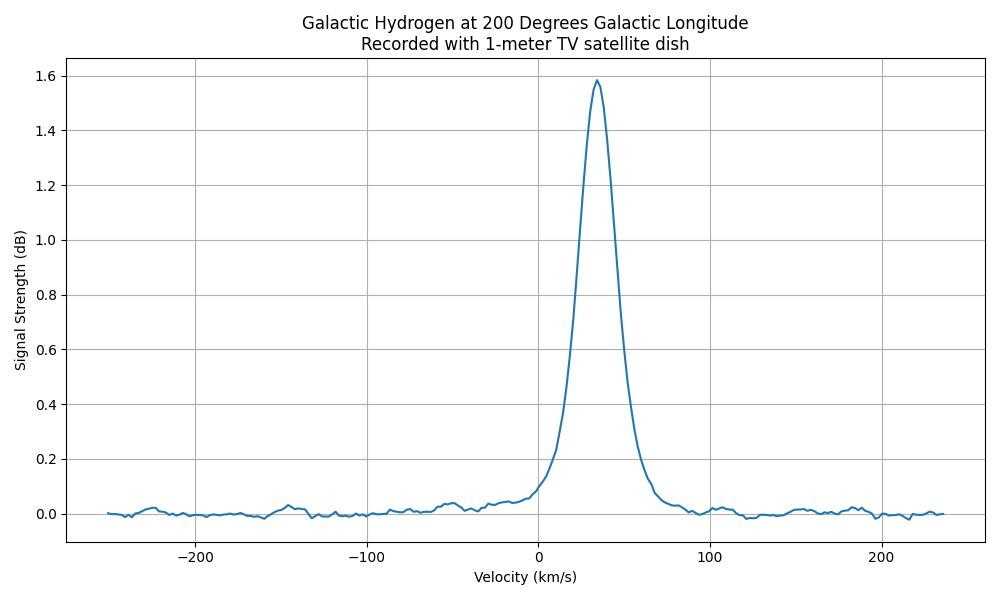
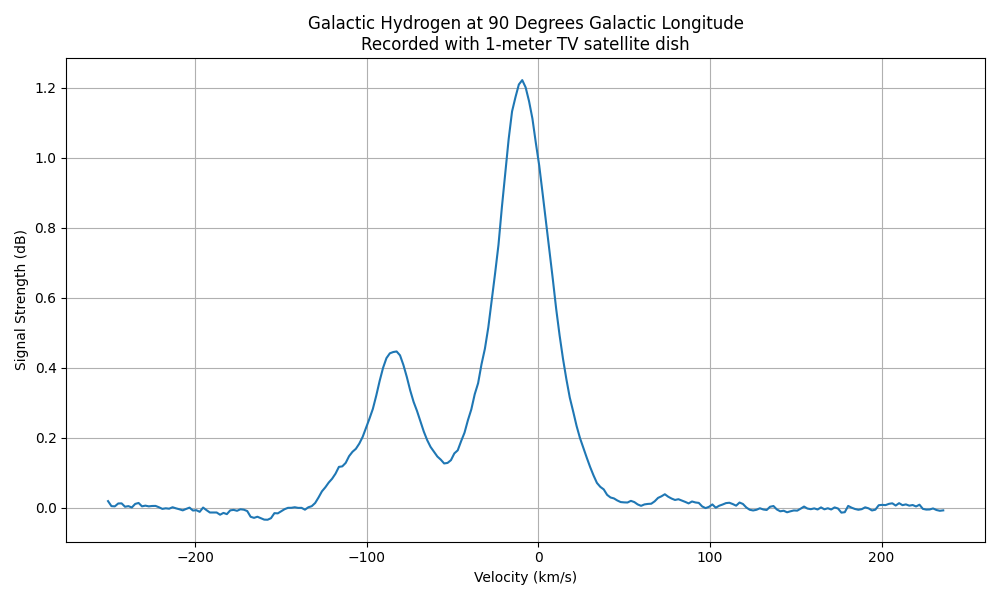
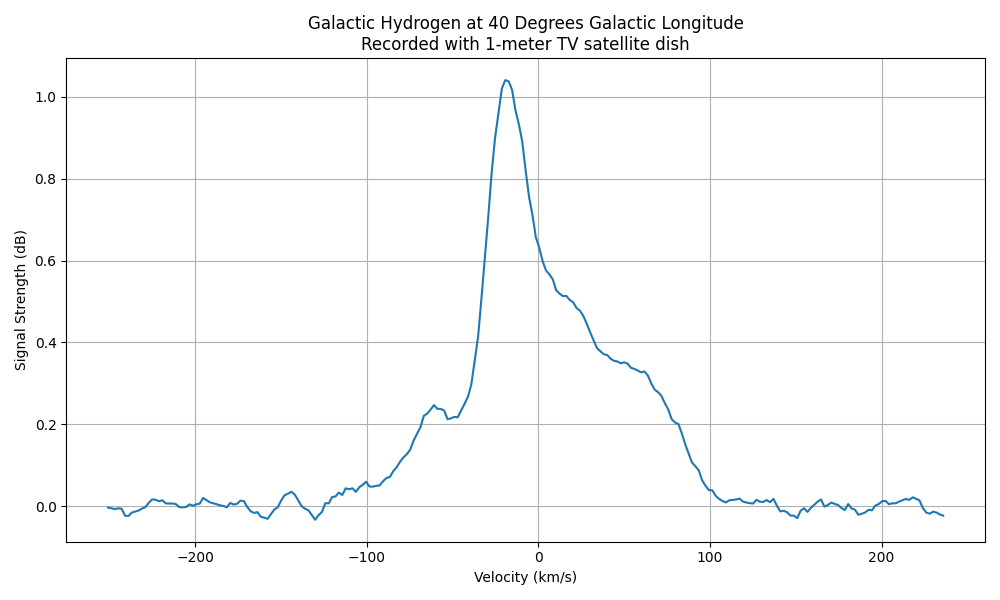
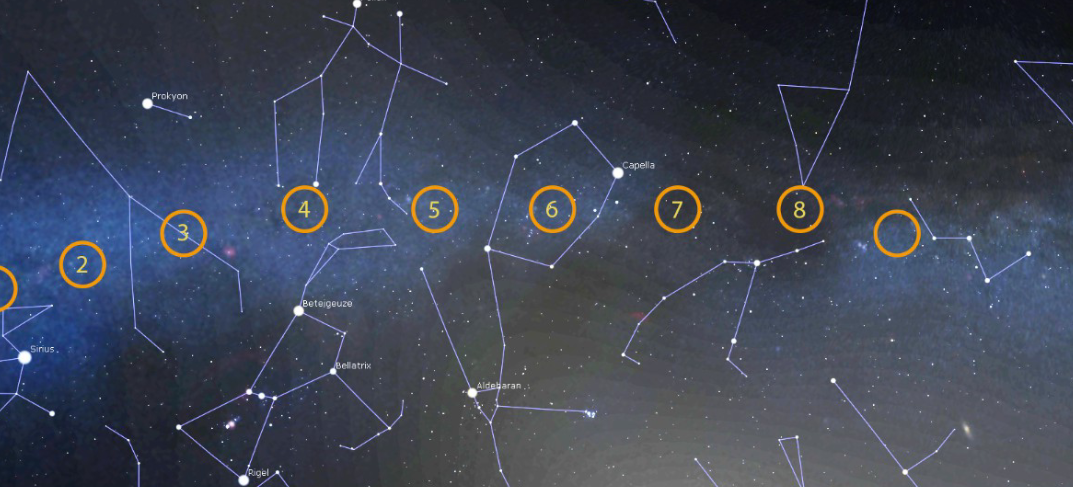
Within about one hour, it is possible to scan the Milky Way along the galactic plane, for example in steps of 15 degrees, and record spectra. The changing spectral shapes can already be observed in real time. From Germany, only part of the Milky Way is visible during the night, while the remaining part can be scanned during the day. Although the Milky Way is not visible optically in daylight, it is still present in the sky. A radio telescope can observe it regardless of daylight or cloud cover.
Spectral Map
The recorded spectra can be combined into a spectral map of the galactic plane. Such a map reveals that there are directions in which the spectra split into multiple peaks, and others where these peaks merge into a single strong feature.
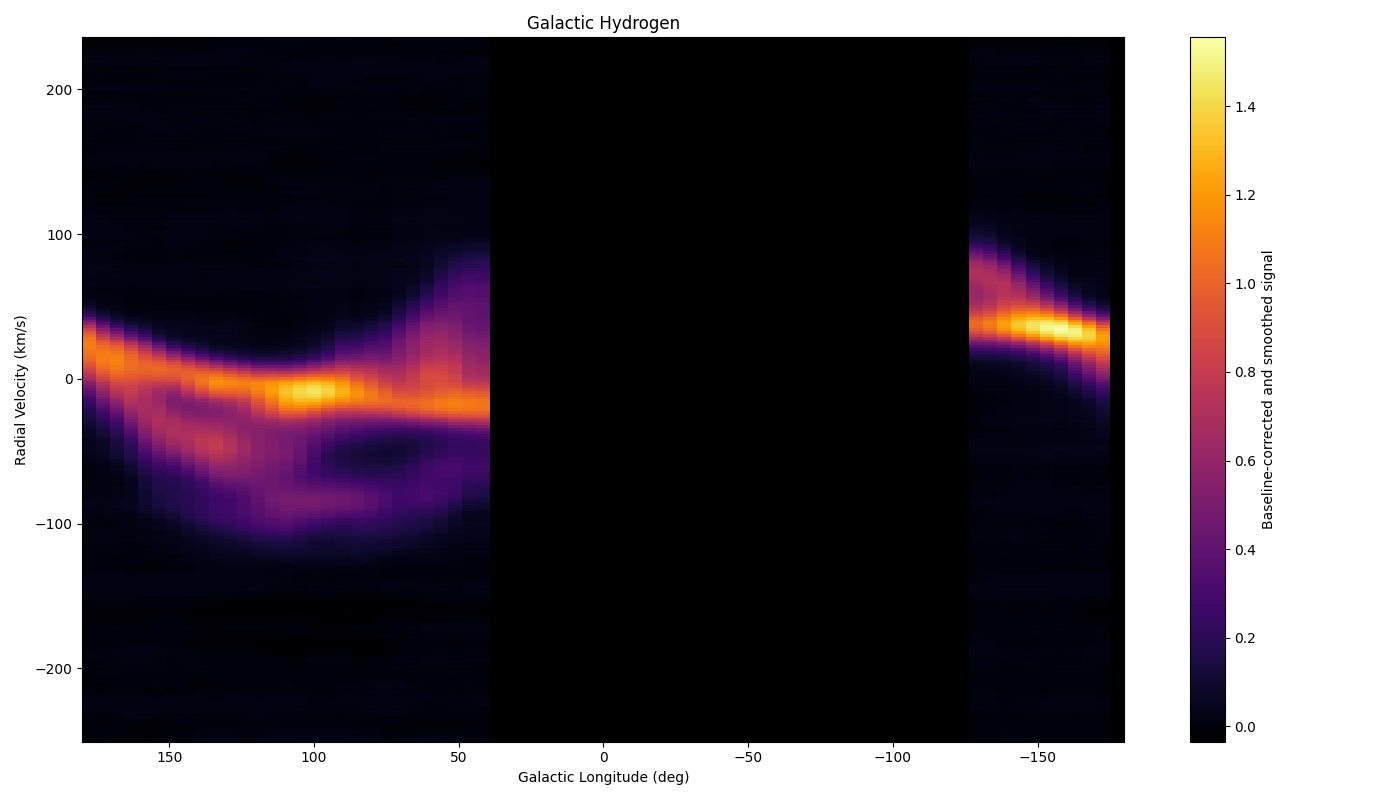
The presence of multiple peaks is a direct indication that we are observing different spiral arms of the Milky Way. This effect arises from the different relative velocities of hydrogen clouds with respect to our local system when observing in different directions. Toward the galactic center or the opposite direction, the galactic anticenter, the relative velocities are close to zero. In these directions, the hydrogen clouds neither move significantly toward nor away from us, resulting in a single spectral peak.
A detailed explanation of how the structure of the Milky Way can be derived from such spectra, and how full-sky scans can be used to generate a map of the galaxy, is given in the section on our all sky H1 survey .
Sky Scan at 1420 MHz
If the bandwidth of an SDR receiver (e.g. SDRplay) is set to about 240 kHz and a total power scan is performed with a center frequency of 1420 MHz, the Milky Way becomes visible in the total power data in the light of the hydrogen line.
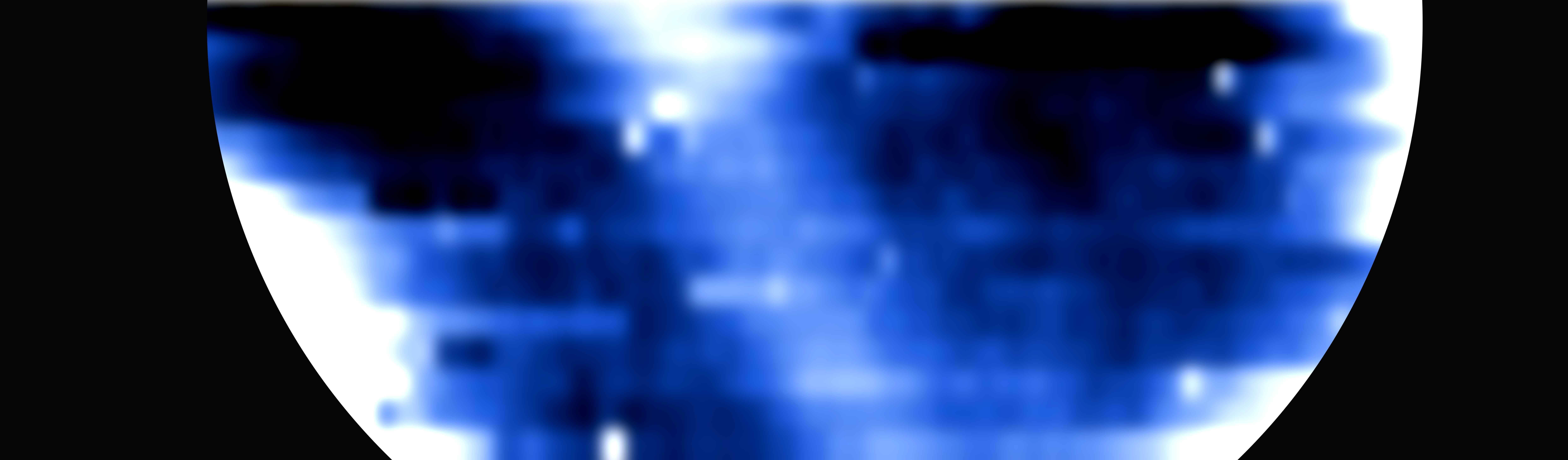
The following image was recorded within about 10 minutes using a 1-meter satellite dish. The sky was scanned line by line in an east–west direction while pointing south. The individual scans were then combined to form a two-dimensional image, clearly revealing the structure of the Milky Way in neutral hydrogen.