Galactic sources: Taurus A
All radio sources — with the notable exceptions of the Sun and the Moon — are intrinsically very weak, making them difficult to observe with small antennas. At higher frequencies, their radio brightness typically decreases further, since their spectral flux density does not follow the behavior of thermal emitters.
Taurus A (the Crab Nebula, M1) is a supernova remnant in the constellation Taurus and one of the strongest non-thermal radio sources in the sky. A notable property is that its flux density decreases less steeply with increasing frequency compared to many other synchrotron sources.
In the Ku-band, Taurus A has a flux density of approximately 500 Jy. For a radio telescope with:
- 1-meter aperture
- ~70% efficiency
- System temperature ≈ 140 K
the expected signal increase is only about 0.005 dB
This extremely small value illustrates the fundamental challenge of continuum observations of weak galactic sources using small amateur instruments.
Observations (February–March 2026)
At the end of February 2026, Taurus A was observed on three consecutive days using the Second Receiver.
The observing procedure was as follows:
- Initial pointing calibration using the Moon and a red-dot finder
- Precise mount alignment using multiple reference stars
- Selection of M1 (Taurus A) via GoTo
- Positioning the antenna slightly ahead of the source
- Letting the source drift through the beam due to Earth’s rotation
The measurements were performed with an integration time of 1000 ms.
The first set of figures shows the resulting transit curves from the three observing sessions.

Influence of RFI (Starlink Interference)
A dominant feature in the data are strong spikes caused by Starlink interference.
- These signals appear despite the use of bandpass filters
- Starlink transmissions are so strong that they can penetrate the filter, although attenuated
- For an extremely weak source such as Taurus A, even attenuated interference remains dominant
This clearly demonstrates the challenge of observing faint continuum sources in the Ku-band under heavy satellite interference conditions.
Detection and Verification
Despite these challenges, a signal increase of approximately 0.005 dB was successfully detected — fully consistent with theoretical predictions for a 1-meter dish with ~70% efficiency.
In addition:
- The measured half-power beamwidth (HPBW) matches the theoretical expectation
- The observed transit shape agrees well with the expected antenna beam pattern
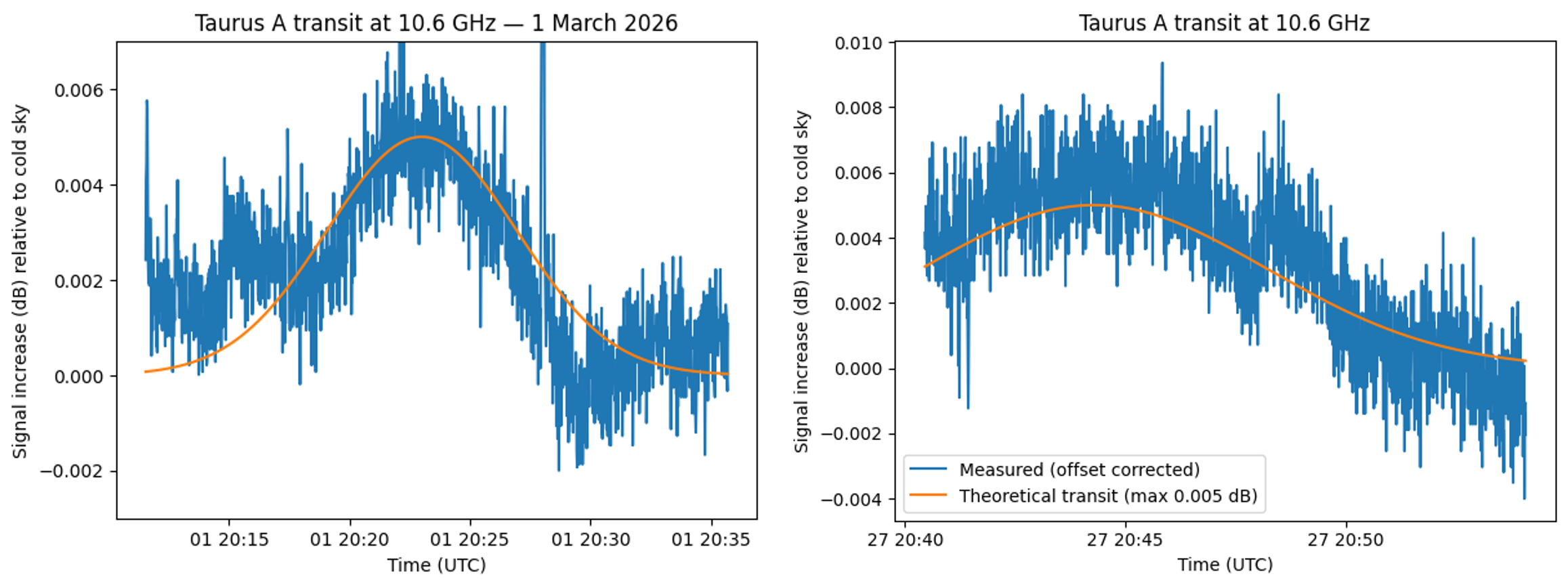
The second set of figures shows:
- The measured transit curves
- A theoretical transit curve (orange) overlaid on the data
The agreement between model and observation is very good, confirming the validity of both the measurement and the theoretical assumptions.
Averaging Multiple Observations
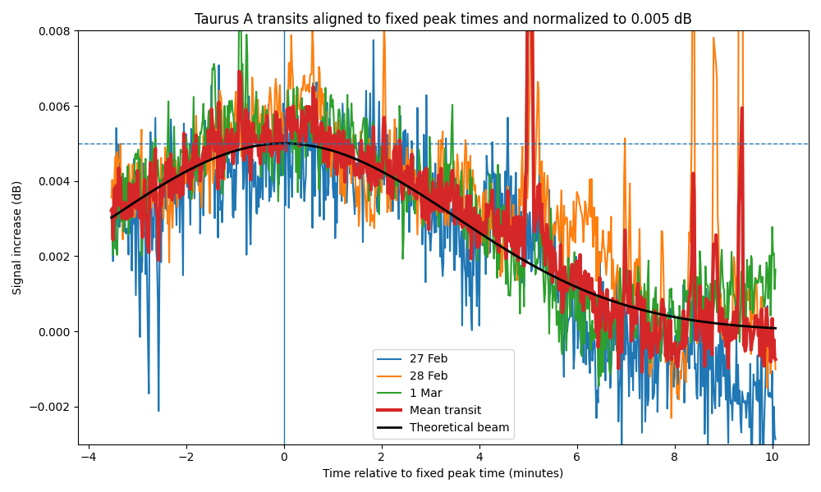
In the final figure:
- All three transit measurements are combined
- The average transit curve is shown in red
- A theoretical beam profile is overlaid in black
This averaging process significantly reduces noise and improves the visibility of the signal, further confirming the detection of Taurus A.
Conclusion and Outlook
This experiment demonstrates that even extremely weak continuum sources — at the level of only a few thousandths of a dB — can be detected with small amateur instruments, provided that:
- careful calibration is performed
- multiple observations are combined
- and interference effects are properly managed
Following the successful detection of Taurus A, the next logical step is to attempt observations of other sources with similar flux densities, such as:
- Cassiopeia A (Cas A)
- Orion A
The Second Receiver opens the door to a broader exploration of galactic radio sources with relatively simple equipment.